Urban Vitality · P12 · UE5 Logic Prototype
P11 tested vehicle spacing, pedestrian risk, avoidance, damage, and recovery on a single road. P12 pulls the camera back to a city block. It maintains 300 stable vehicle identities and also accepts two cross-system presentation inputs: a logical population total of 2,048 and a visible population count of 96. The first number belongs to the per-vehicle tier and pooling test. The latter two feed crowd density and ambient-audio requests; they do not mean that this map is simulating 2,048 pedestrian identities.
Related analysis: Urban Vitality P6 | Open-World Traffic Presentation (not published yet)
Introduction: City scale does not come from copying full vehicles
A visible car costs more than one mesh. A near-field vehicle may carry wheels, collision, lights, material parameters, audio sources, tire effects, damage parts, and interaction components. Keeping all 300 logical vehicles alive as full Actors would grow CPU, rendering, physics, and audio work together. A population system would hit the same wall if it expanded every logical resident into a complete pedestrian Actor. P12 consumes the aggregate values 2,048 and 96; it does not expand or advance that many pedestrian records in this fixture.
The source project does not solve traffic presentation with one neat Full–Proxy–Instance–Distant state machine. Traffic slots retain lightweight motion facts. Entity categories select component bundles at spawn time. Local vehicle motion has its own distance bands. A separate anonymous point system handles traffic farther away. These mechanisms control identity, motion, queries, and presentation at different boundaries.
Far traffic in the source does not need a complete vehicle record. Direction, coverage, speed, and density are enough to form a moving texture. Stable identity, body dimensions, and consumable events become necessary only when a vehicle enters an interactive range. The presentation layer can therefore lend expensive resources to a small subset of identities instead of turning every logical object into an Actor.
P12 turns that principle into a UE5 city-scale acceptance fixture. It is not a final-quality scene. Near and Mid still use blockout vehicles, Far uses lane-flow markers, and audio and effects stop mostly at request and budget validation. The point is narrower: limited presentation resources must move safely between many persistent identities. Final vehicle assets, lighting, Niagara, sound fields, GPU impostors, and platform tuning belong to the later presentation and L2 integration stages.
1. The source control planes do not collapse into one LOD enum
1.1 Logical traffic exists before vehicle entities
The source traffic slot stores spline position, direction, vehicle dimensions, local path, expected conflicts, and stop reasons. A materialized entity reads its target pose from that state. Releasing the entity does not have to stop the traffic record.
This is not the same as reducing polygon count:
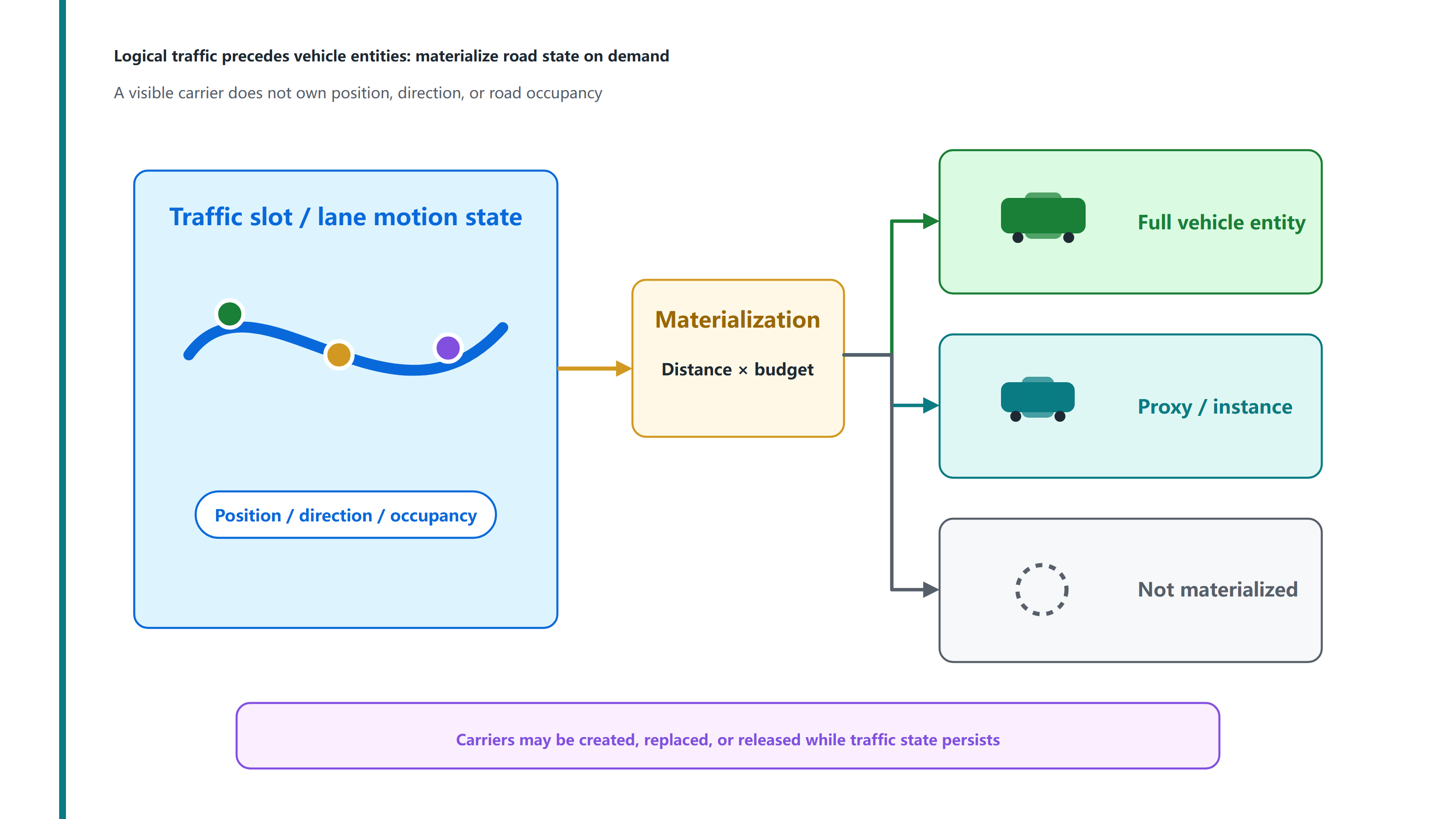
A vehicle may still occupy the road logically without owning wheels, audio, or collision. Conversely, a distant luminous marker can add traffic density without owning a trackable vehicle identity.
1.2 The source deliberately drops identity in the far field
The source distant-traffic system creates anonymous points from nearby lanes, view distance, density, and appearance type. A point can move along a lane, switch appearance, and add background traffic motion, but it does not retain mission state, interaction history, or a complete vehicle entity. Its job is to create a stable motion texture.
P12 does not copy that design literally. This prototype needs to test VehicleId handoffs across Near, Mid, Far, and Hidden, so the current FarFlow retains member IDs, lane IDs, and lane alpha, then aggregates them into a small number of visible lane bars. That is a validation choice, not evidence that the source keeps identity for every distant point. A production system can anonymize again at a greater distance, provided the anonymity boundary and re-entry rules are explicit.
1.3 A tier transition must preserve three kinds of continuity
City traffic usually exposes three failures first:
- Spatial continuity: position, heading, and route progress cannot jump when the carrier changes.
- Identity continuity: one
VehicleIdcannot be owned by two visible runtime objects at once. - Event continuity: every transition needs an explicit keep, regenerate, or discard rule. A one-shot presentation event must not replay because of a demotion, promotion, or checkpoint restore. Noncritical feedback suppressed in Far or Hidden may be dropped deliberately; gameplay-critical events need a separate world-event record.
P12 therefore tracks more than the current tier counts. Diagnostics include duplicate Actors, identity errors, handoff count, deferred transitions, pool reuse, Far members, and visible route-wrap violations. A total of 300 is only the first invariant.
What the source distance systems actually trim.
The source mechanisms below come from the P6 code-path and responsibility analysis. P12 carries their constraints into UE5, but does not reinterpret them as one source-side LOD state machine.
| Control plane | Main object | Cost it trims |
|---|---|---|
| Population / vehicle entity category | Spawn-time entity bundle | Components, interaction, baseline cost |
| Full-simulation switch | Visible vehicle entity | Grounding, prediction queries, local motion fidelity |
| Local vehicle distance band | Vehicle-motion internals | Conflict corridor, candidate objects, expensive checks |
| Anonymous distant traffic | Separate point system | Motion texture and density only |
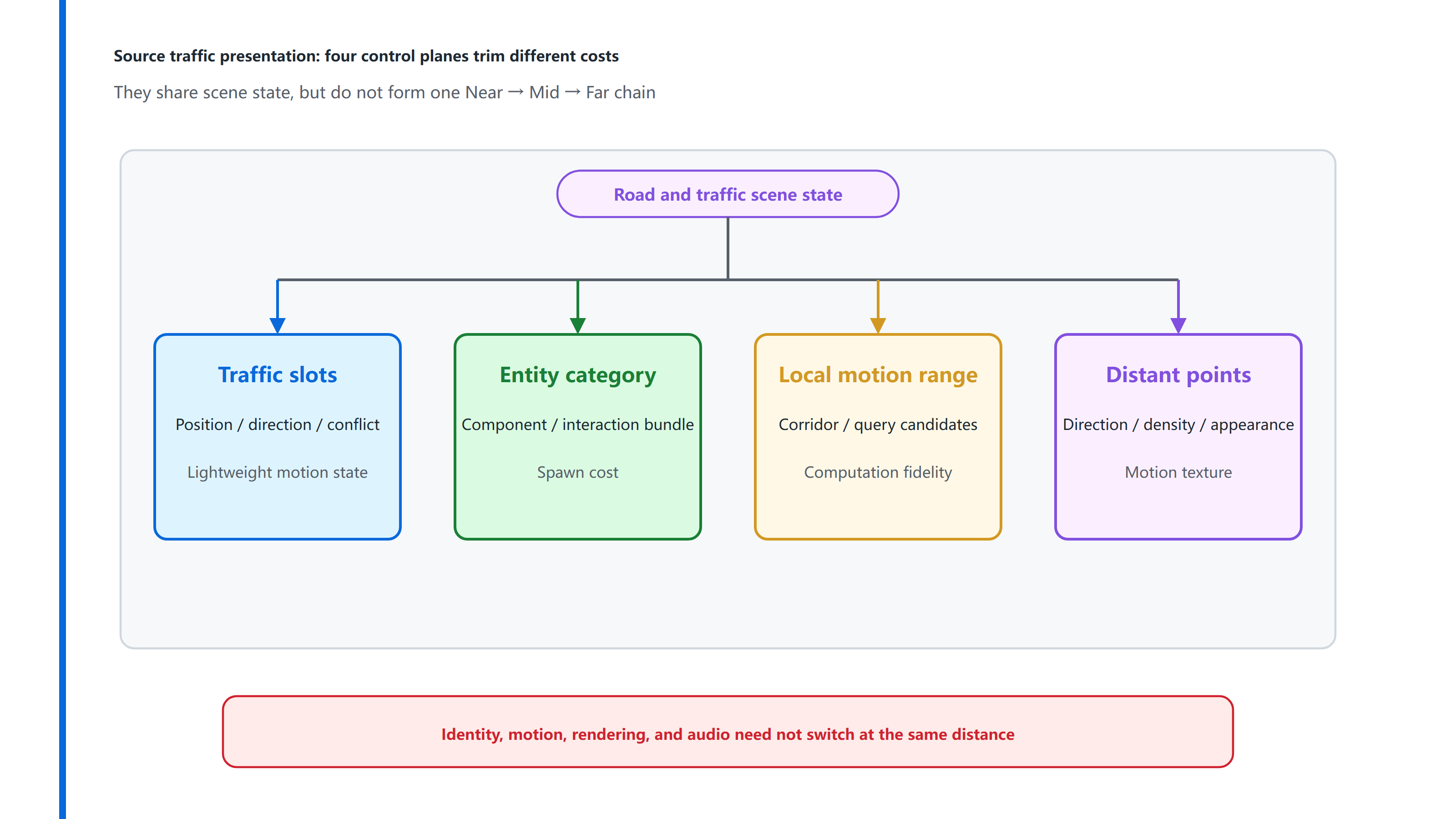
A visible near entity may stop running an expensive conflict query while remaining on screen. A distant point may never have had vehicle identity at all. These controls cannot be flattened into a single enum, and crossing one distance cannot imply that identity, physics, rendering, and audio all switch together.
P12 concentrates UE5 representation allocation into Near, Mid, Far, and Hidden. That is useful for testing, but it is not a field-for-field reproduction. A production version may split motion-fidelity LOD from visible-representation LOD again.
A handoff may overlap visually without creating two owners.
Single logical ownership does not mean that only one pixel source can exist during a transition. The old instance may fade out while the new representation acquires the target pose and fades in. Logical ownership must already be settled, though: two runtime objects cannot both report the same vehicle to collision, event, or interaction systems.
P12 stores Tier, PreviousTier, and visibility separately for this reason. Duplicate-identity checks inspect runtime bindings, not the number of rendered instances. The same distinction must survive if the blockout later becomes a dissolve, cross-fade, or GPU impostor transition.
The presentation layer requests resources; it does not promise them.
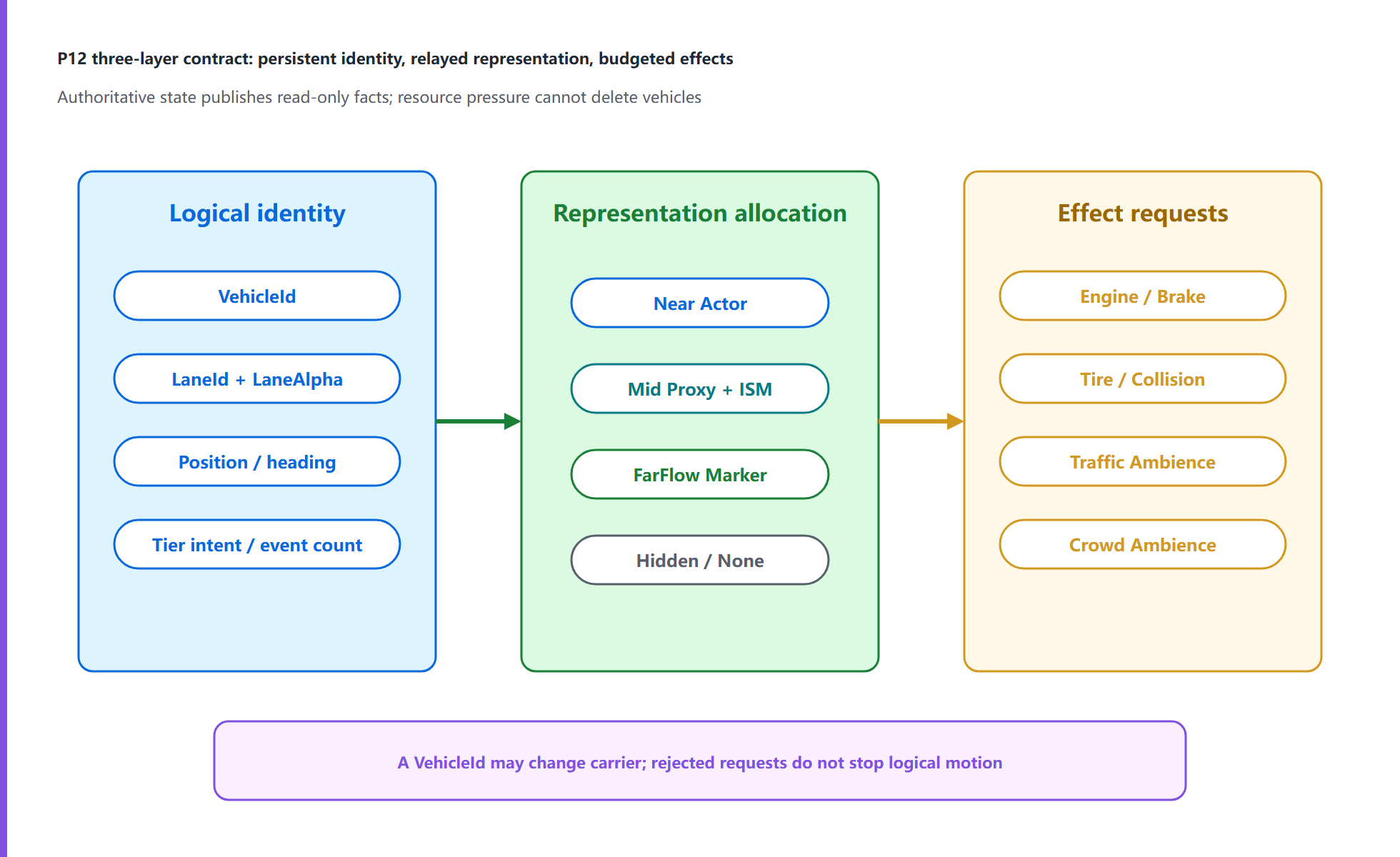
Braking, tire slip, engine loops, and collision impacts become structured requests. The P12 showcase creates and counts those requests. A separate Effect Pool Runtime has validated sorting, allocation, and rejection by type, priority, and budget. A submitted request proves that a logical event is consumable. It does not prove that the main showcase has already played final audio, illuminated final lights, or spawned production Niagara effects.
That boundary keeps presentation pressure from changing simulation. A distant vehicle continues moving without a dedicated audio source. A rejected impact request does not undo damage. P12's Event Request count measures presentation demand, not visible effect count.
2. How much logical state fits in one city fixture
2.1 The showcase and regression maps have different jobs
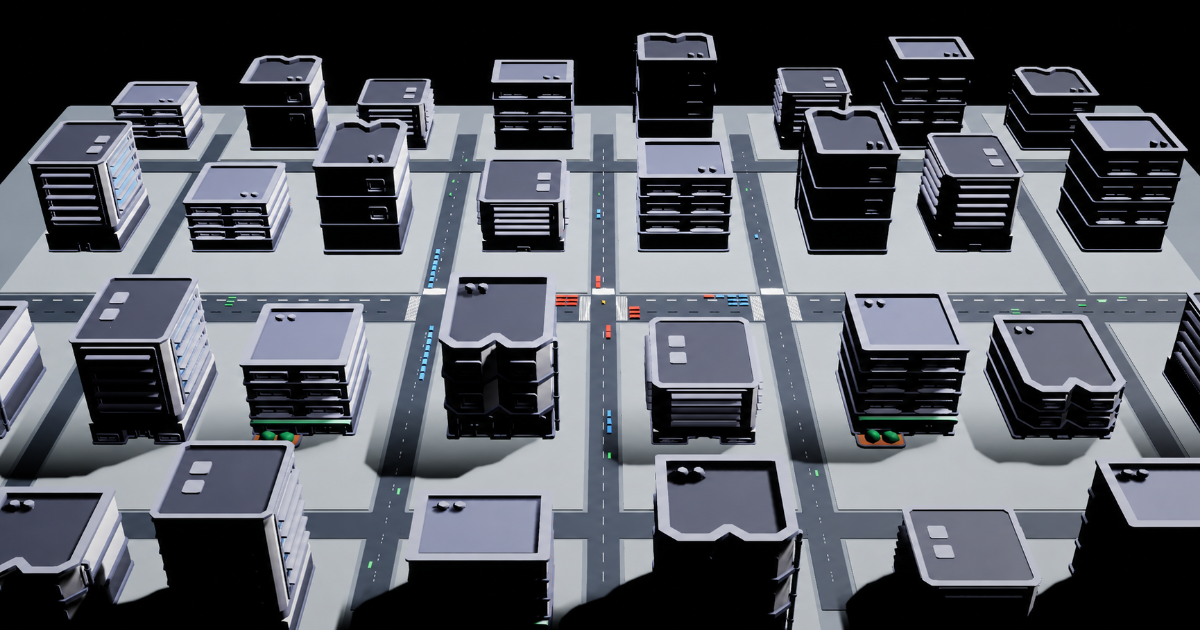
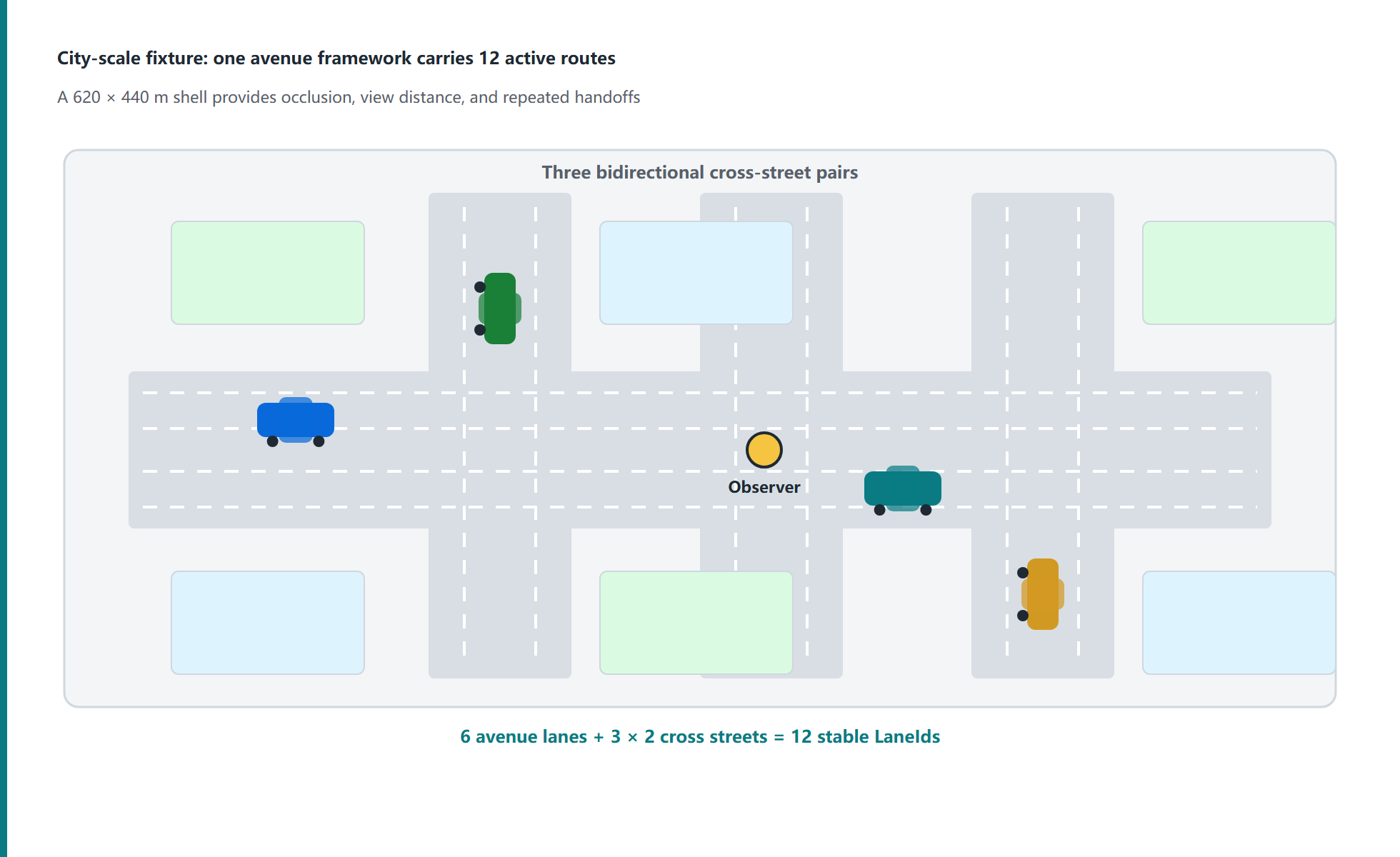
The interactive showcase uses a roughly 620 × 440 m city shell, a 520 m avenue, three active cross streets, four ambient roads, 24 blocks, and 32 accepted building meshes. A smaller regression map runs the same runtime for automation and quick checks. The article keeps the reproducible dimensions and responsibilities without exposing internal asset paths.
The city shell is not a complete open-world background. It provides enough street length, occlusion, and observer travel for Near, Mid, and Far to coexist and for repeated representation handoffs to occur.
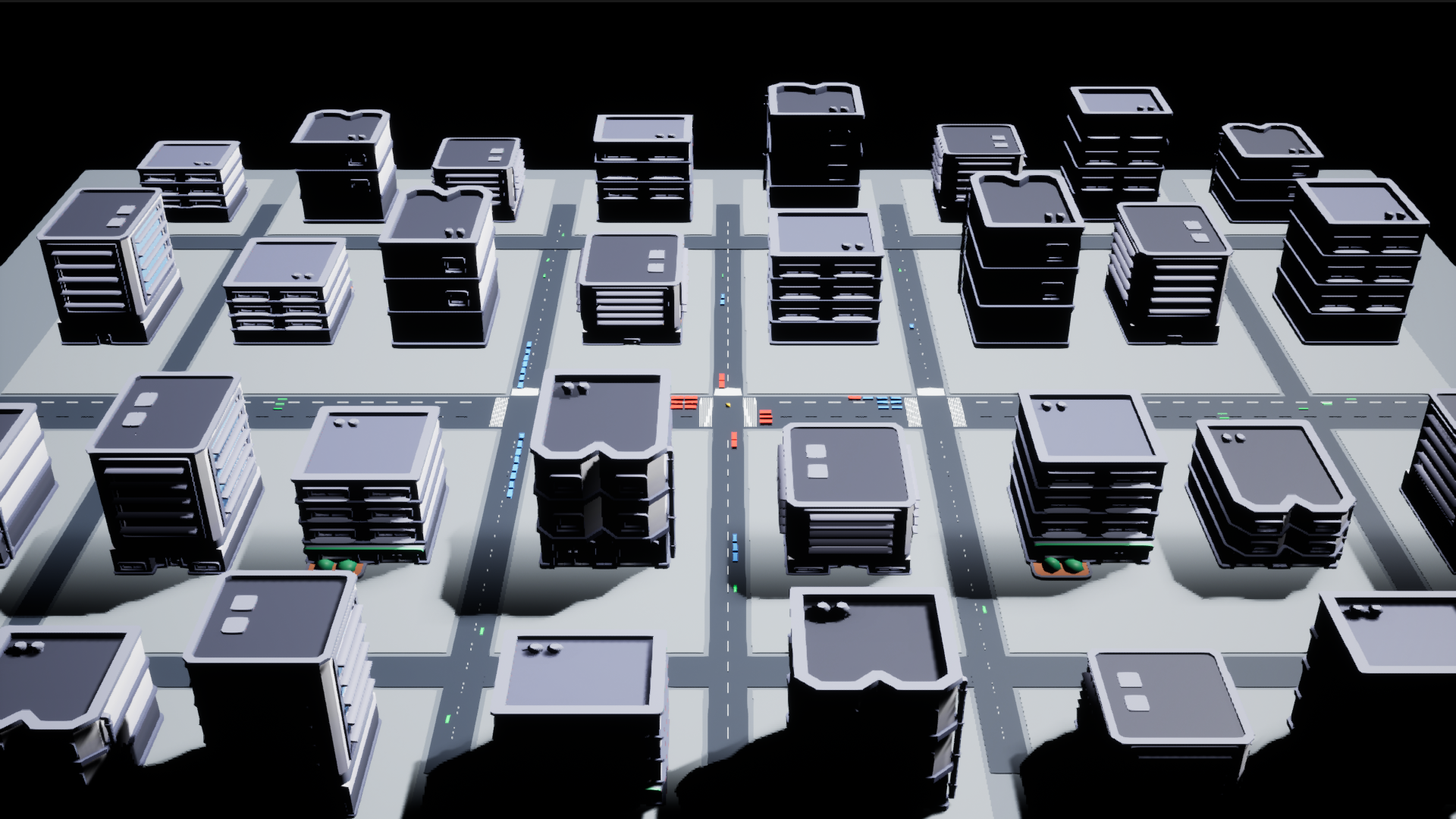
Evidence note: Use this frame to inspect the city shell, avenue, cross streets, and building occlusion. With the HUD hidden, it establishes fixture scale and road layout only; it is not runtime-count evidence.
2.2 Three hundred logical vehicles share twelve routes
The demo uses six avenue lanes and three bidirectional cross-street pairs, for twelve routes in total. Three hundred stable VehicleId values are distributed in rotation, with a phase stride offsetting the initial slots. Exclusion zones near intersections prevent initialization inside a conflict area.
Logical traffic keeps advancing along those routes. Avenue speeds are about 12.0, 12.8, and 13.6 m/s; cross streets use about 9.0 and 9.7 m/s. Vehicles on one route keep at least 5 m center spacing. Three intersections run 24-second signal cycles with phase offsets, opposing-occupancy checks, and downstream-capacity checks. Even in a presentation-scale article, visible cars cannot ignore queues and pass through each other, or near motion and distant density would describe two different cities.
The 5 m value is a blockout center-spacing fixture. It is not P11's 7 m bumper-clearance contract with vehicle length and predicted braking. Once P11 motion execution is integrated, body envelopes and the local motion layer should calculate safety spacing.
2.3 The values 2,048 and 96 are aggregate inputs, not pedestrian records
P12 does not maintain 2,048 pedestrian identities in this map. 2048 and 96 are the logical population total and visible population fixtures used by event aggregation. The runtime calculates crowd density from 96 / 2048 and emits one crowd-ambience request. There are no 2,048 AgentId records and no query that found 96 live pedestrian objects.
These values test cross-system scale accounting, Crowd Density, and ambient-audio demand. They do not integrate P10's pedestrian-motion load into the same map or establish final crowd rendering cost. Pedestrian scale and traffic-presentation scale still need separate acceptance tests.
2.4 The observer deliberately crosses tier boundaries
A yellow observer marker travels back and forth along the avenue on a 36-second cycle, covering ±70 m laterally. A deterministic path makes the same identities repeatedly approach, leave, promote, and demote, so pool reuse and transition counts can be compared across runs.
The source retains an option to use the player camera, but the acceptance path uses the automatic observer. It should not be described as a completed camera-focus system. The policy also has view-direction parameters, while bPrioritizeViewerFocus remains disabled. This test ranks mostly by lane-floor coverage, the existing visible cohort, presentation priority, and distance.
The twelve routes are not unrelated spline animations.
Avenue and cross-street traffic share stable LaneId, direction, and alpha data. As a vehicle approaches one of the three intersections, it reads the signal, opposing conflict occupancy, and available downstream length. A green signal is not enough if the exit region is full. A vehicle already inside the conflict region must clear it rather than stopping in the middle after a phase change.
Stop positions account for crosswalk half-width, maximum vehicle half-length, vehicle buffer, and extra safety margin. Avenue and cross-street Stop Offsets differ because the road geometry differs. This is not P9's general reservation system, but it prevents the city-scale fixture from becoming decorative traffic that intersects itself.
Why the initial visible cohort avoids intersections.
Configuration computes each route's intersection alpha, excludes roughly 18 m on either side, and distributes slots across the remaining intervals. A fixed Phase Stride multiplied by route index offsets each lane. With 300 / 12, each route holds 25 logical slots, enough to cover avenue and cross streets while keeping the minimum spacing. The initial visible cohort is then selected from alpha 0.25–0.75 so the opening frame already has readable road texture.
Warm-up time is not recorded demo time.
After configuration, the demo advances one signal cycle, clears startup traffic, and applies an avenue-green offset. It temporarily removes promotion and demotion limits to establish the initial representations, then performs an all-red settle before resetting recorded elapsed time to zero.
This keeps the first frame from combining 300 record initializations, signal startup, and 60 representation acquisitions. It does not bypass the runtime: warm-up calls the same vehicle advance and representation systems. Automation also checks steady-state execution instead of accepting one frozen post-warm-up screenshot.
3. Four tiers allocate cost, not four sets of vehicles
3.1 The current budgets are 24 / 36 / 48
| Tier | Budget | Current visible form | Actor required |
|---|---|---|---|
| Near | 24 | Blockout full-vehicle Actor | Yes |
| Mid | 36 | Mid-range proxy / ISM | Pool retains a proxy; screen uses instances |
| Far | 48 logical members | Lane-aggregated flow markers | No |
| Hidden | Remaining identities | Not drawn | No |
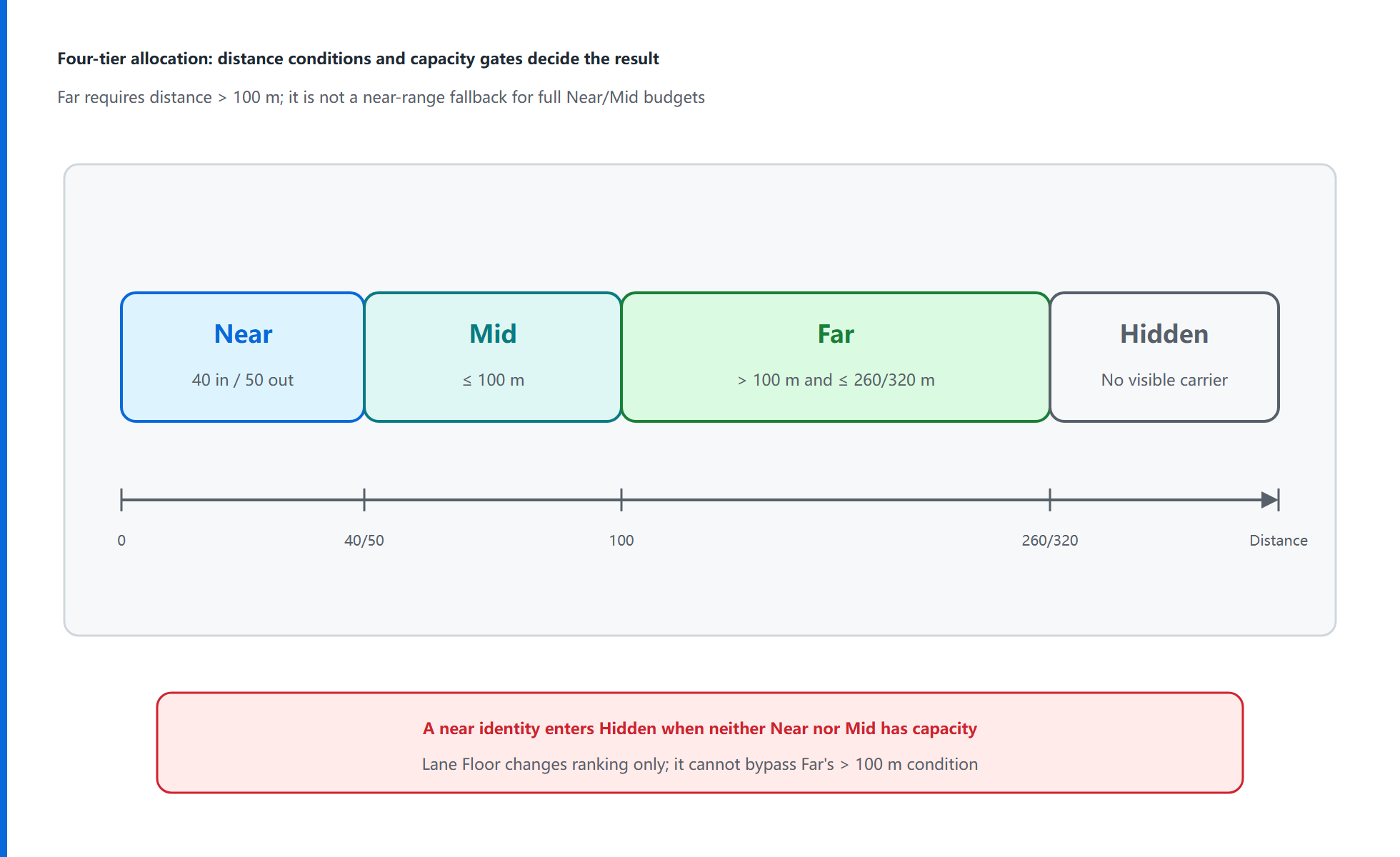
Near enters within 40 m and exits at 50 m. Mid reaches 100 m. Far enters at 260 m and exits at 320 m. Separate enter and exit thresholds add hysteresis where implemented and prevent constant boundary chatter.
The Far value of 48 is a logical-member budget, not 48 distant objects. Far members are aggregated by lane; each route draws at most five markers, and at most twelve lane-level FarFlow records exist. Logical members, aggregate records, and instances are separate ledgers.
Two unrelated resources also happen to have a maximum of 60:
| Ledger | Count and meaning |
|---|---|
| Logical vehicle identities | 300 |
| Near / Mid / Far member caps | 24 / 36 / 48 |
| Maximum non-Hidden members | 108 |
| Minimum Hidden at full tier budgets | 192; actual count may be higher |
| Near + Mid materialization pool | 60 reusable Actor / Proxy slots |
| FarFlow lane aggregates | Up to 12 |
| Visible FarFlow markers | 1–5 per lane, theoretically up to 60 ISM instances |
The Near/Mid slots belong to the materialization pool. The theoretical 60 FarFlow markers belong to an instanced draw set and never enter that pool. Equal numbers do not make them the same resource.
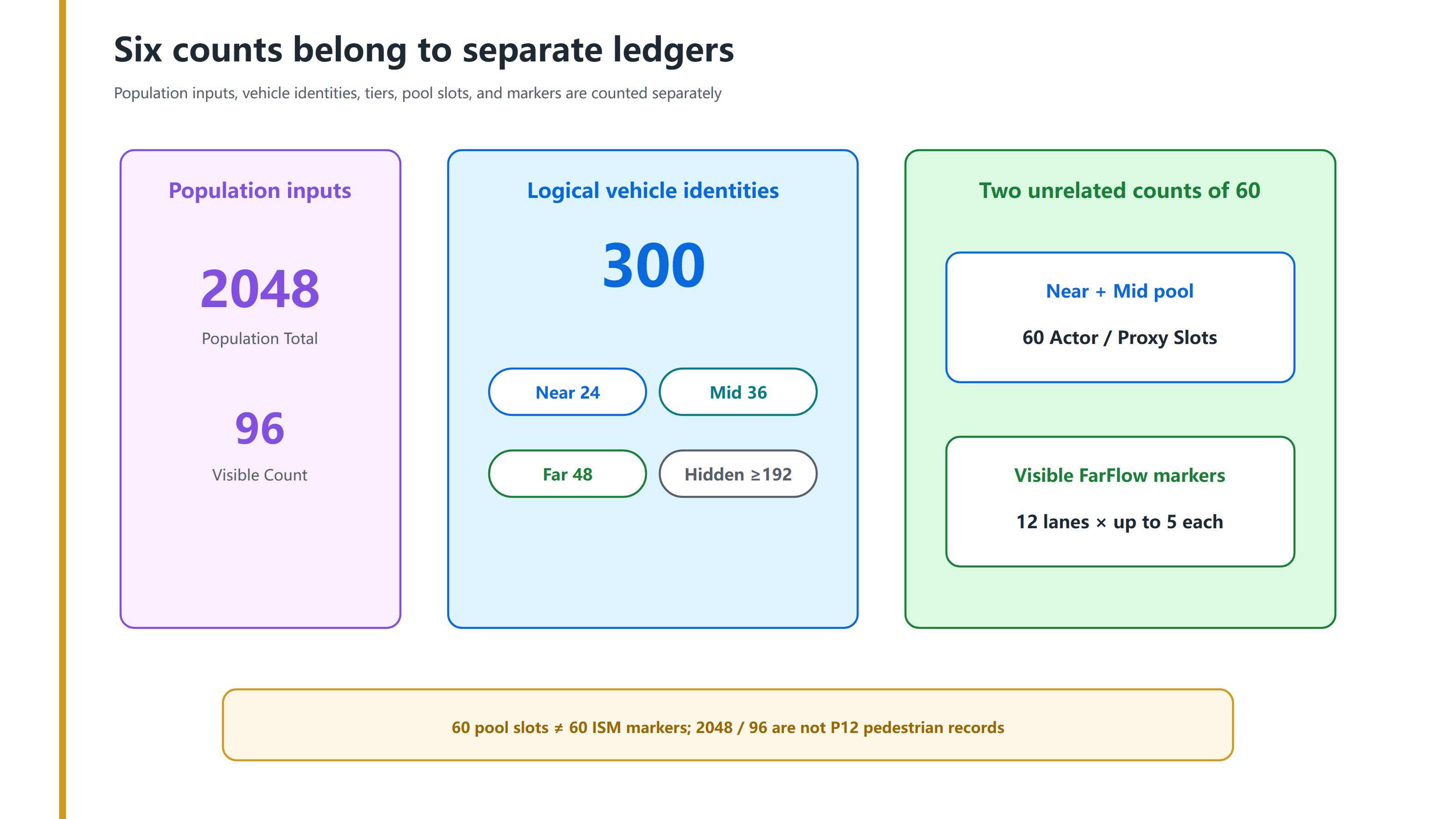
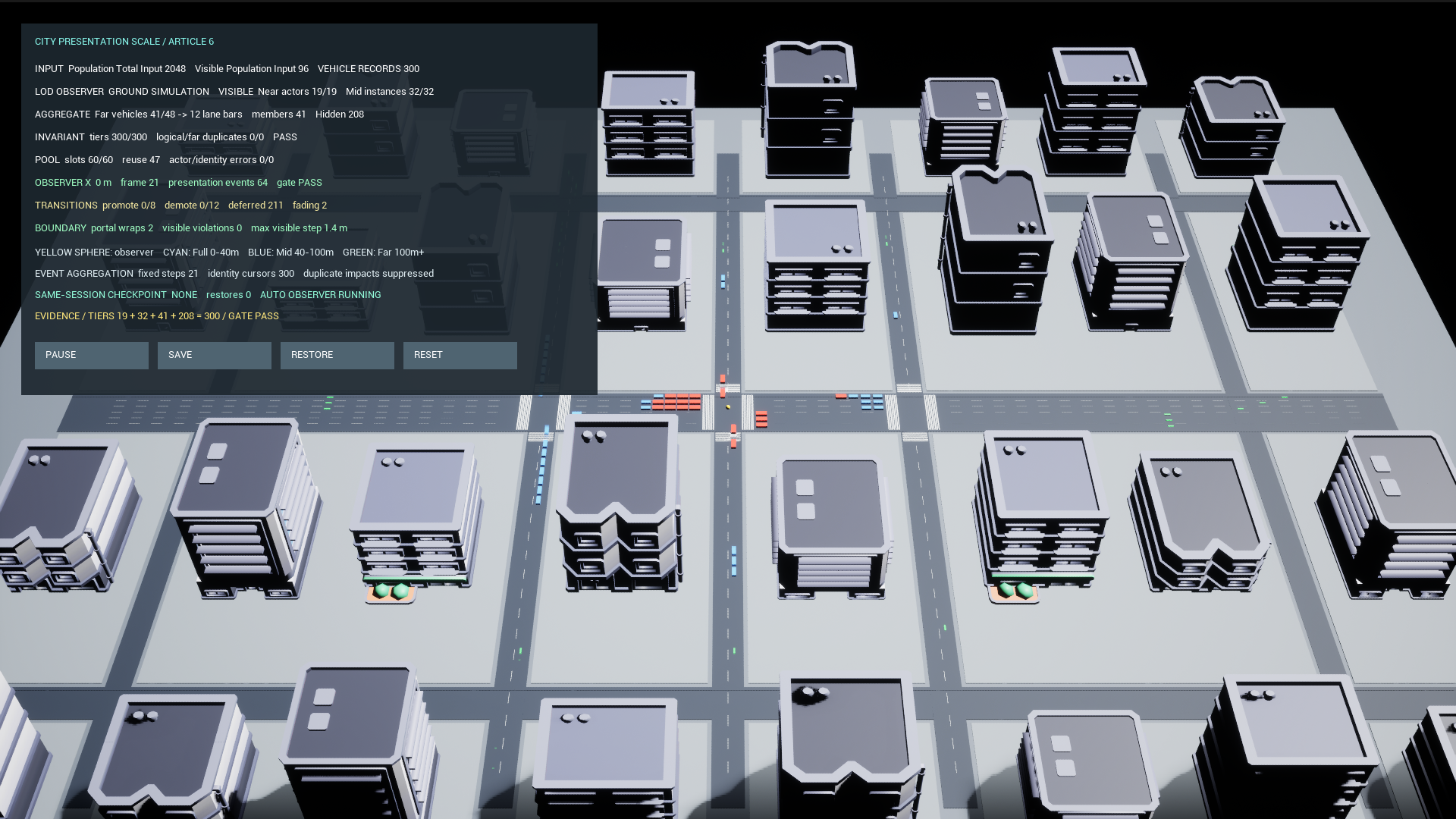
Evidence note: Check that all four tiers sum to 300, Near/Mid/Far stay within 24/36/48, and the materialization pool remains at 60 slots. The 2,048/96 values are cross-system population inputs, not part of these 300 vehicle identities.
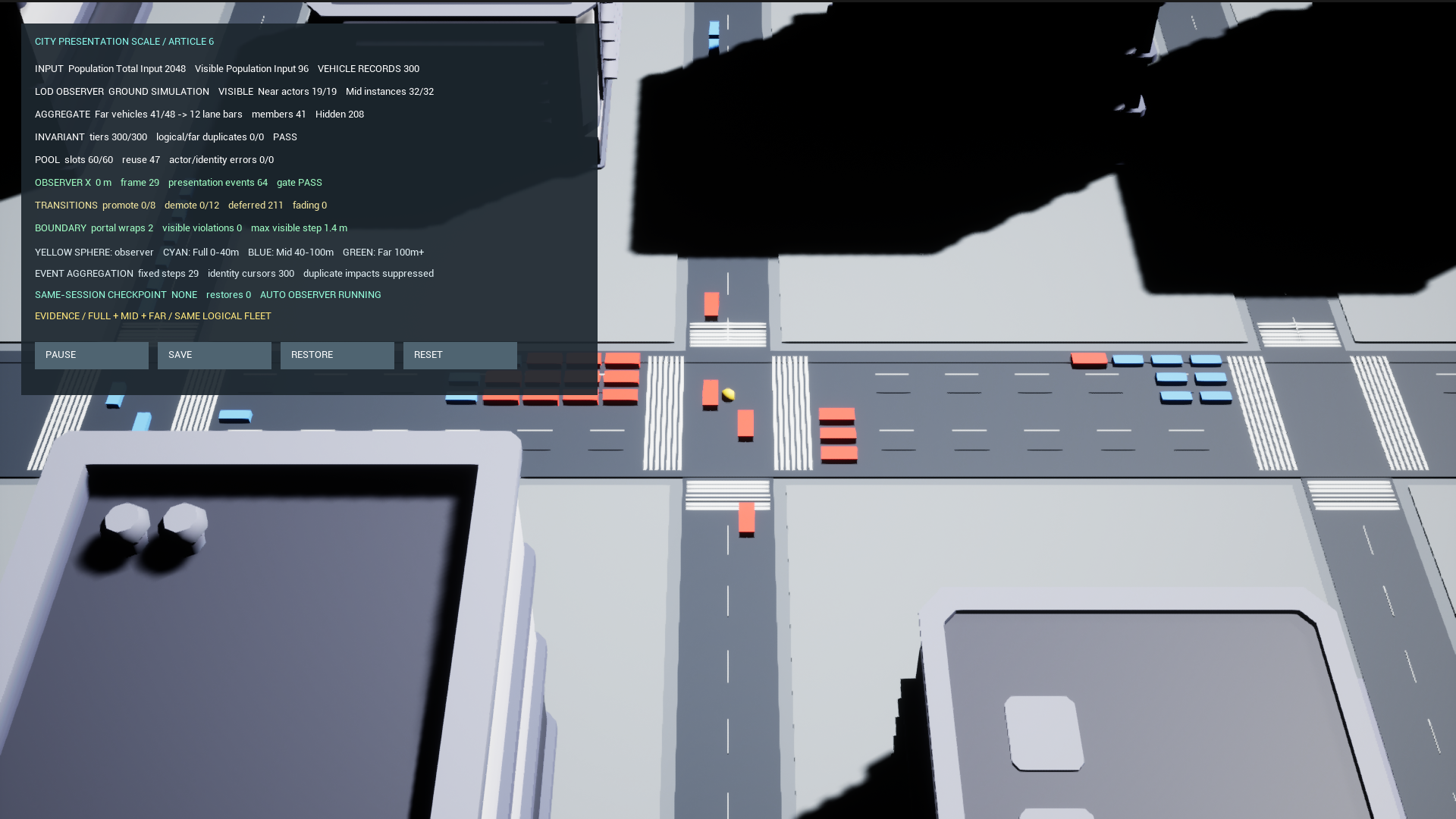
Evidence note: Cyan Near Actors, blue Mid instances, and green FarFlow markers appear together. All three derive from the same VehicleId state table. The colors and blocks are debug semantics, not final vehicle art.
3.2 Ranking preserves road coverage before comparing distance
Pure distance sorting creates an obvious failure: when the observer approaches one junction, nearby lanes can consume every slot and distant roads become empty. P12 nominates at least one visible candidate from every route, then places those lane-floor identities at the front of the global ranking.
Within a lane, the current visible state also affects order. With bPreserveVisibleCohort enabled, an already visible identity receives a small preference so a slightly closer newcomer does not replace it every step. Distance is compared after lane coverage and cohort stability.
Lane Floor is a fixture policy, not a final art rule. A chase camera, high aerial shot, or interior view may require a different coverage objective. This test proves that a fixed budget can keep traffic texture on every active road rather than retaining only the globally closest N vehicles.

3.3 Promotions and demotions have per-step limits
During normal execution, one 0.1-second fixed step applies at most eight promotions and twelve demotions. Excess requests do not all take effect at once. If the current tier still satisfies its distance condition and can retain a compatible slot, the vehicle stays temporarily and increments the deferred count. If its representation is beyond the safe distance and it is not a lane-floor member, it may hide immediately.
Visibility changes over 0.8 seconds. Each state stores Tier, PreviousTier, Visibility, and transition counts. A demoted Mid instance can remain visible while its alpha decays, then disappear after the fade completes. Near and Mid ownership is handled separately by pool synchronization.
That fade currently works most completely on the Mid ISM ↔ Hidden path. Near Actor release and FarFlow set reconstruction remain more direct, and Near ↔ Mid is primarily release-then-acquire. P12 validates state and ownership handoffs; it does not claim a symmetric two-way cross-fade between every tier.
Transition limits cap Actor creation, release, and state-change spikes in one fixed step. A fast observer move creates measurable transition debt instead of forcing every rebuild into one frame.

3.4 Hidden is still a logical vehicle
A Hidden vehicle retains:
VehicleIdandLaneId;lane alpha, world position, and heading;- previous tier, visibility, and transition count;
- intersection, spacing, and route-advance results.
It owns no Actor and emits no per-vehicle engine loop, brake light, or tire effect. Hidden means “no visible carrier right now,” not “deleted from the city.” When the observer returns, allocation uses the current logical state to request a new carrier.
How one allocation pass combines distance and capacity.
Each pass initializes remaining Near, Mid, and Far capacities to 24, 36, and 48, builds the ranking, then tests each candidate in order:
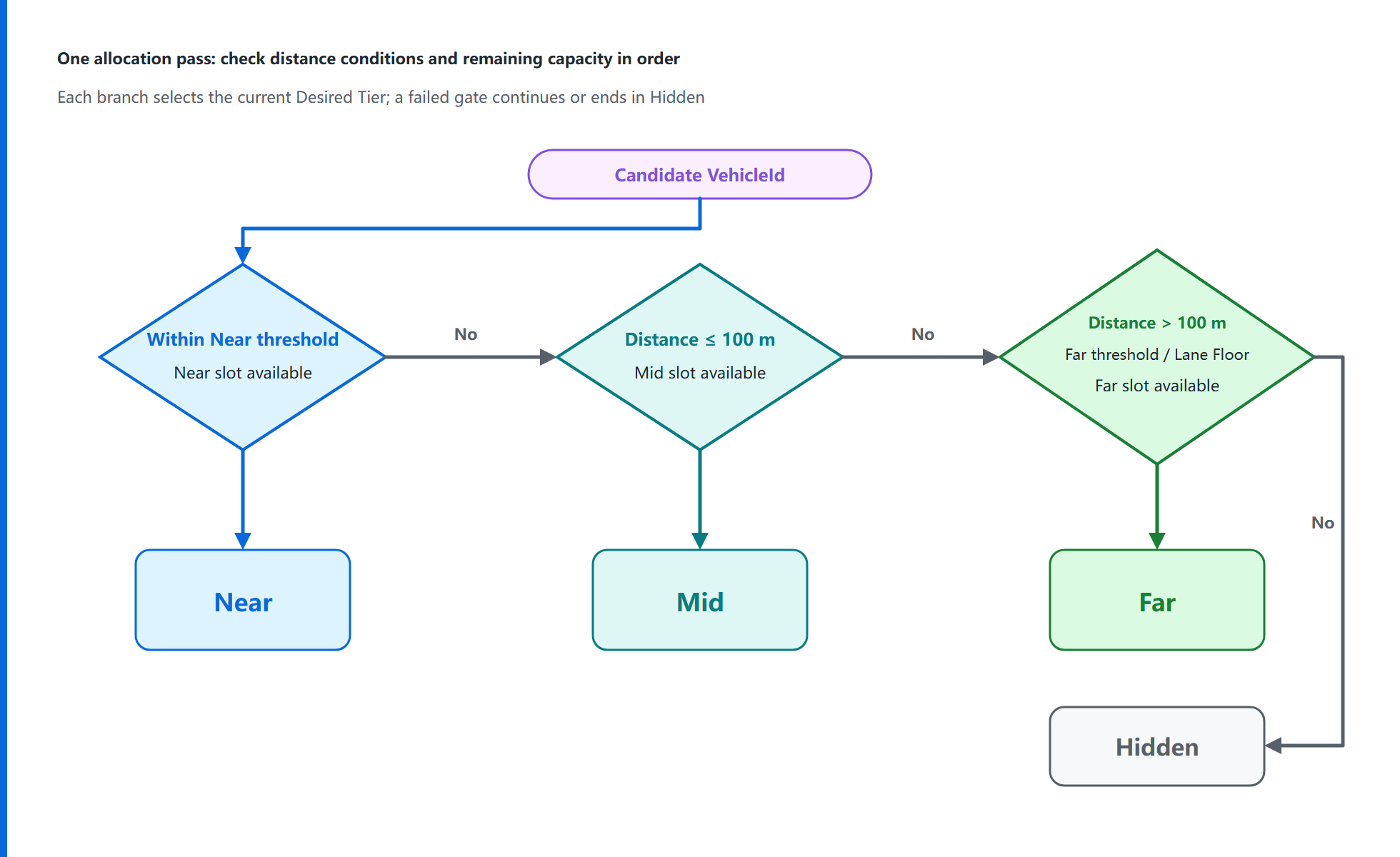
Far is not a catch-all after Near and Mid fill up. A vehicle closer than 100 m that cannot obtain either Near or Mid capacity goes directly to Hidden. Lane Floor changes ranking priority but cannot bypass this distance condition. A product that requires every near object to keep a cheap representation needs an explicit near-range fallback.
Near has separate 40 m entry and 50 m exit thresholds. Far uses 260 m for entry and 320 m for exit depending on whether the current state is Hidden. Mid currently has a 100 m outer limit but no separate entry-hysteresis field. The implementation is therefore not a perfectly symmetric dual-threshold machine across all tiers.
Why a transition-limit miss has two possible results.
A Desired Tier above Current Tier is a Promotion; one below it is a Demotion. Once the per-step cap is reached, a compatible old tier can be retained and the newly reserved capacity returned. That records a Deferred Transition without making the vehicle vanish merely because this step is busy.
If the old tier has already crossed its compatibility distance, keeping it may leave the wrong fidelity beside the observer. A non-lane-floor identity can become Hidden immediately. This path gives up the fade to honor the distance boundary; lane-floor identities still favor road coverage.
AppliedPromotion, AppliedDemotion, DeferredTransition, and TransitioningVehicleCount must be read together. Deferred means a tier change has not been applied. Transitioning means it has been applied but visibility is still moving toward its target.
The stable visible cohort is a deliberate demo trade-off.
Logical advance clears PresentationPriority each step, so bPreserveVisibleCohort does most of the work of keeping current identities on screen. It makes video evidence easier to follow and stops slightly closer Hidden vehicles from constantly replacing a visible queue.
A production ranking will probably include mission vehicles, player focus, accidents, rare types, and objects approaching interaction range. P12 exposes priority and focus-direction fields, but those rules are not enabled in this acceptance fixture. An available interface is not evidence of completed behavior.
4. Sixty slots relay three hundred identities
4.1 Materialization is keyed by VehicleId
Representation state uses a VehicleId → MaterializedRepresentation map. A record holds lane, progress, tier, representation kind, a weak Actor reference, and transition counts. Synchronization first verifies that all 300 logical identities are unique, then checks whether each existing Actor is still compatible with its target tier.
When a vehicle no longer needs an Actor, or when its Near/Mid representation kind changes, the old Actor returns to the pool. The logical identity remains in the traffic table; only its current carrier reference is cleared.
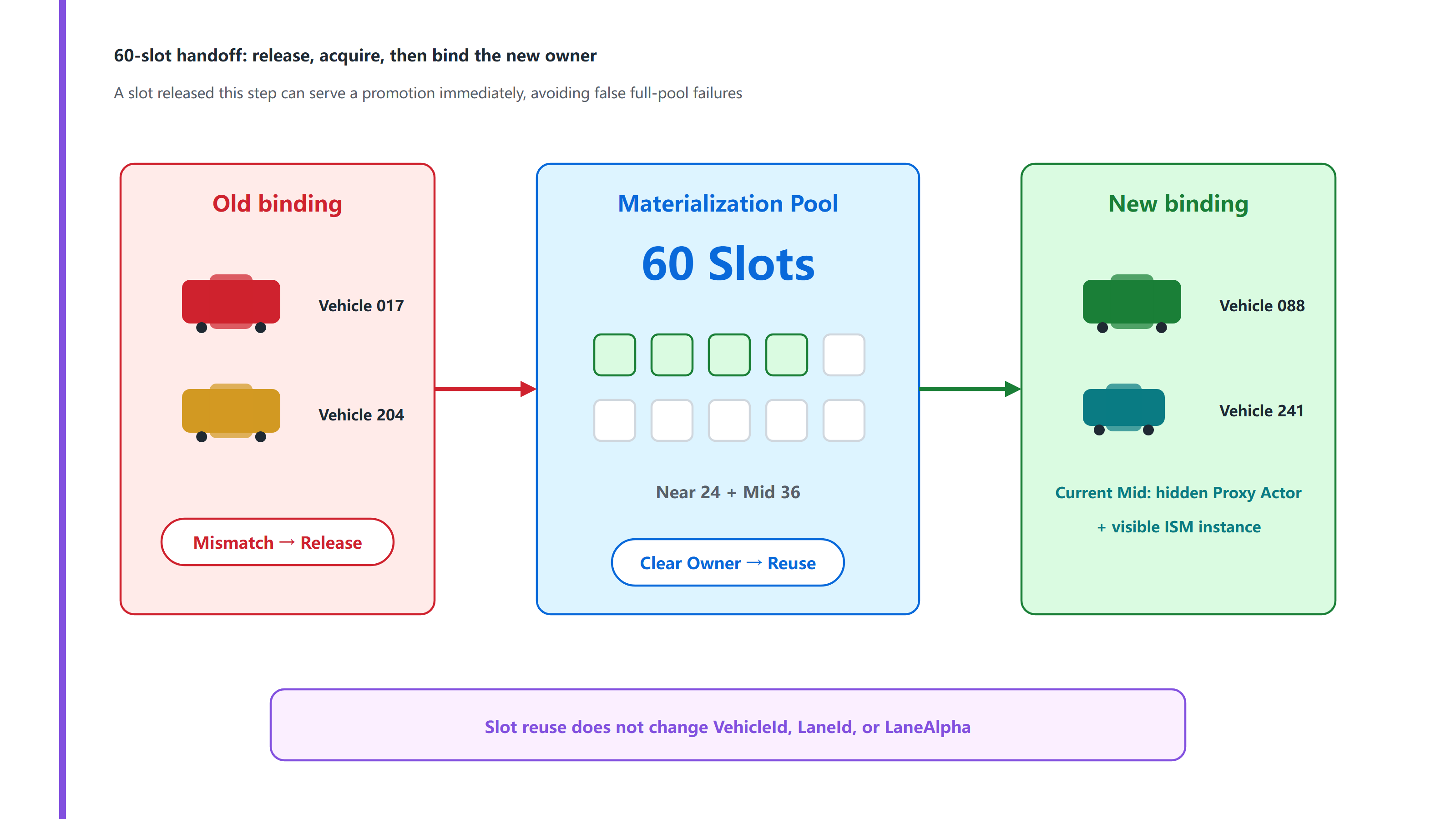
4.2 Release must happen before acquire
The synchronization pass follows release-before-acquire:
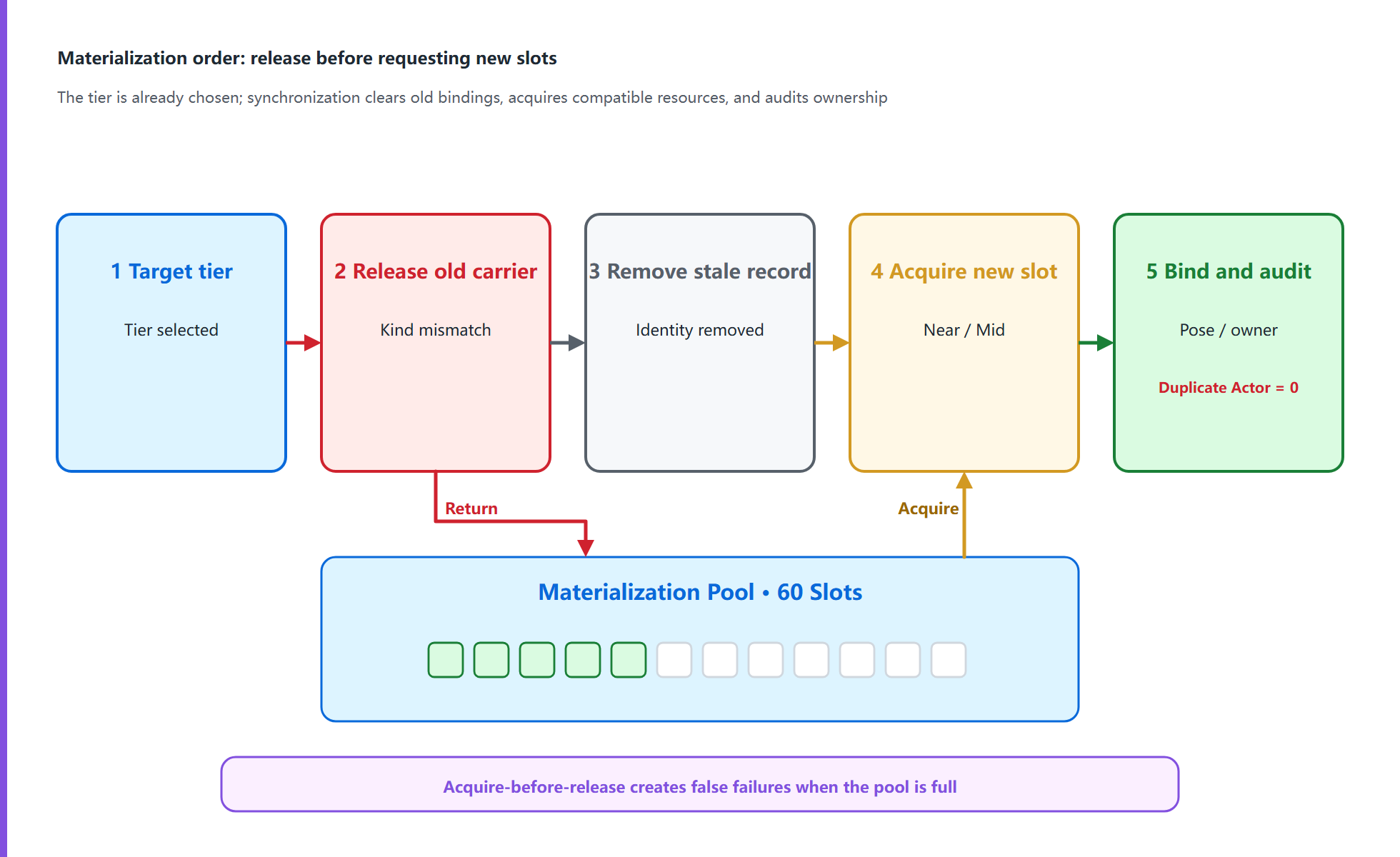
A slot freed by a demotion can serve another promotion in the same step. Reversing the order creates false failures in a full pool: a resource is about to become available, yet the new identity waits an extra step because acquisition ran first.
Near is capped at 24 and Mid at 36, so the materialization pool never needs more than 60 slots. The immediate Scale Gate checks that upper bound and current ownership uniqueness. Growth in PoolReuseCount is different evidence: it comes from warm-up and longer observer loops, not a condition that must already be true on the first frame. Together they show that observer motion reuses carriers instead of spawning an unlimited series of Actors.
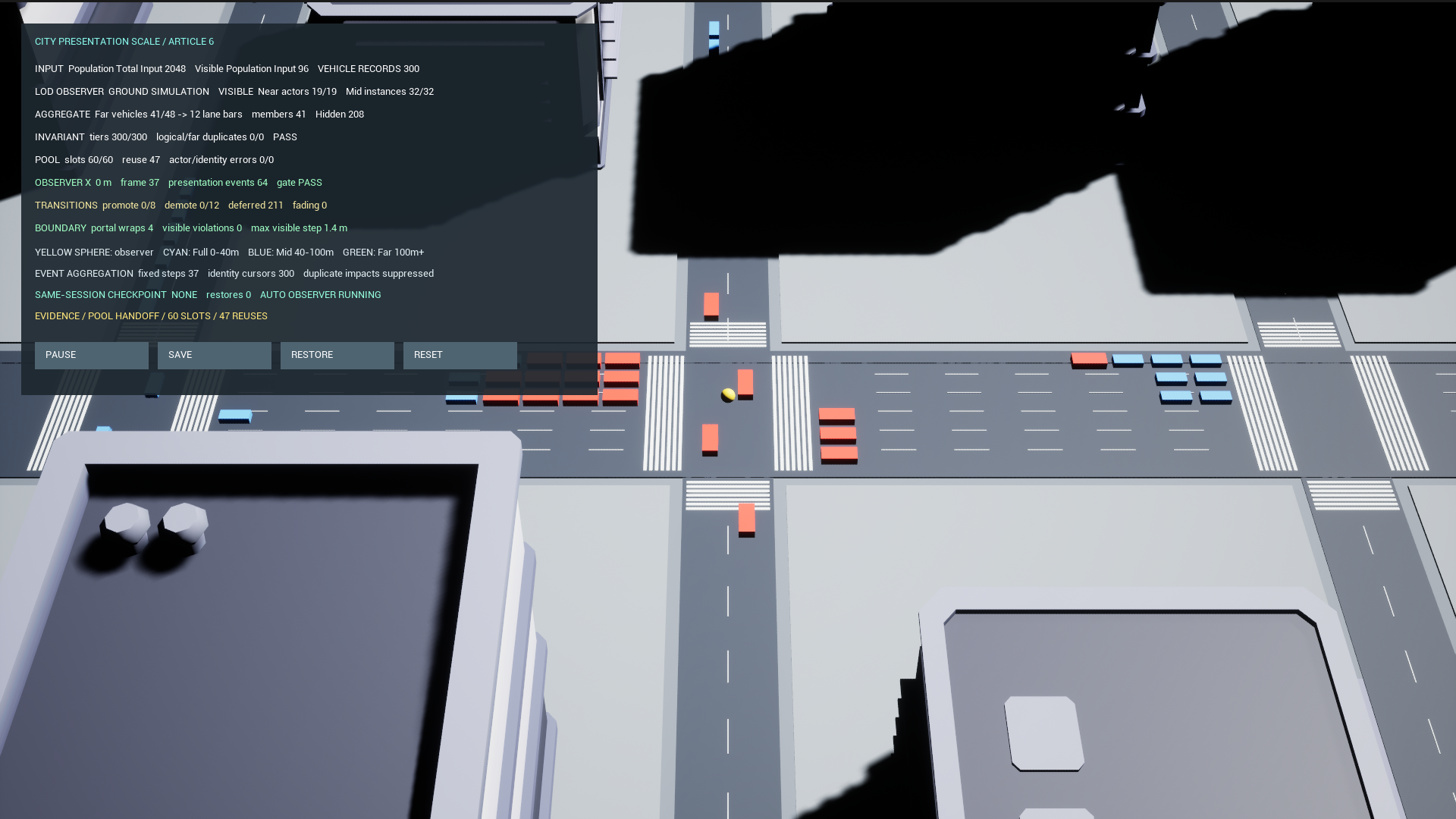
Evidence note: After the observer moves, Pool Slots remains 60/60, Reuse continues to rise, and Actor/Identity Errors stays at 0/0. This verifies resource relay and ownership constraints; it is not a target-platform performance result.
4.3 The Actor does not own identity
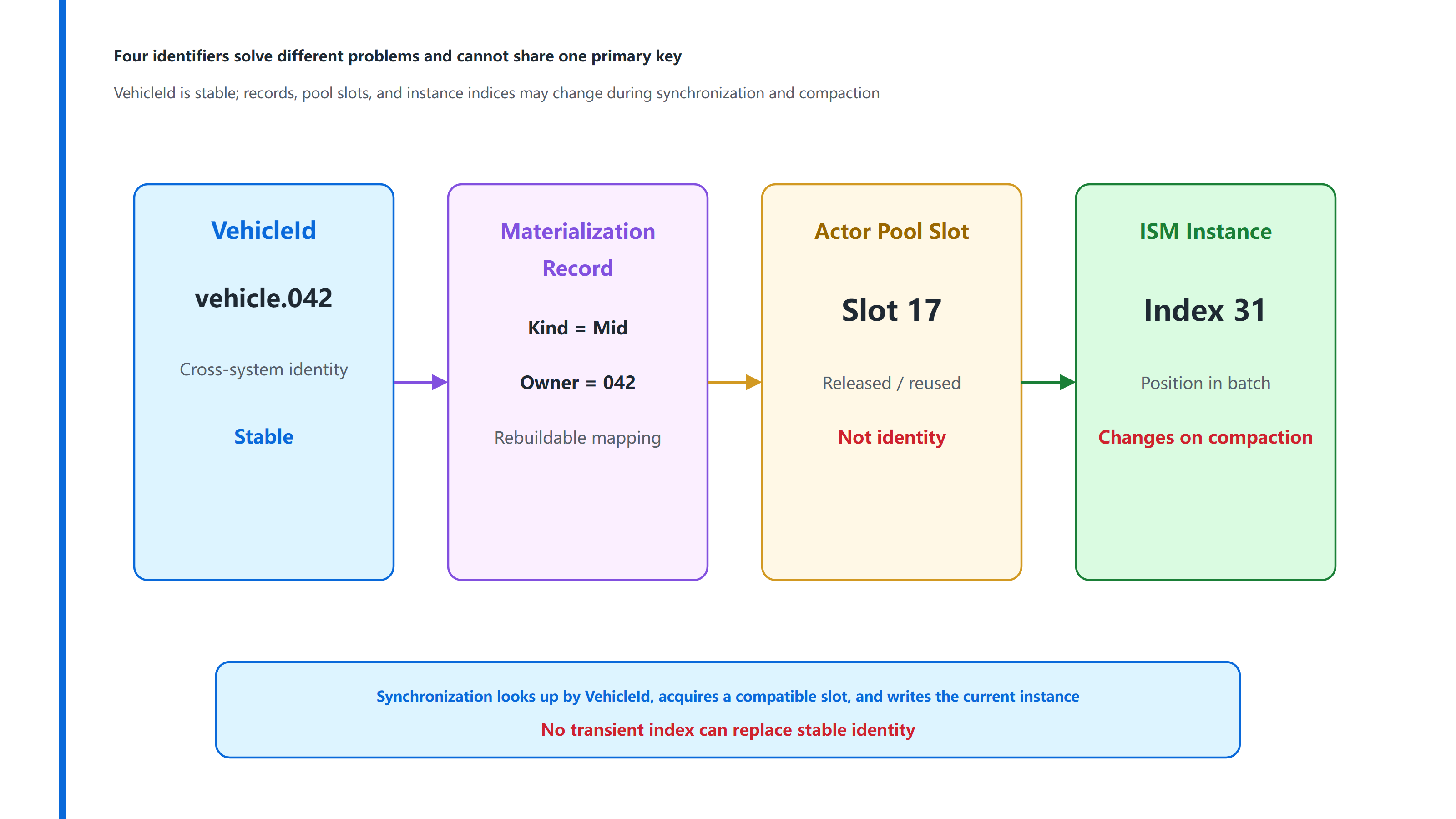
A released Actor clears its old binding. Its next acquisition writes a new VehicleId, position, and heading. Continuity lives in Presentation.Vehicles, not at an Actor address. A slot may represent vehicle.article6.017 now and vehicle.article6.204 one second later, while both logical vehicles retain their own route progress.
Two counters make ownership failures visible:
DuplicateActorCount: whether one Actor is assigned to multiple identities in the same step;IdentityErrorCount: duplicate IDs, inconsistent bindings, or a FarFlow member ledger that does not conserve identity.
Both must remain zero. A screenshot containing sixty cars cannot reveal that one logical identity was duplicated while another was overwritten.
4.4 The current Mid implementation is a validation compromise
The materialization runtime acquires a proxy Actor for Mid to test Near/Mid kind changes and pool ownership. During visible refresh, that Mid Actor is hidden and a UInstancedStaticMeshComponent draws the blockout vehicle. Near displays its pooled temporary Actor directly and audits the visible Actor count separately.
This combination is not a production rendering architecture. A final Mid tier may live entirely in instance batches, without a per-vehicle proxy Actor, or use GPU Scene, Mass representation, or a project-specific batcher. P12 fixes the identity–slot–instance handoff contract, not the temporary component layout.
Pool slots and logical vehicles have different lifetimes.
A slot cycles through available, acquired, released, and reused resource states. The vehicle keeps advancing along its route throughout. Releasing an Actor does not remove its state from Presentation.Vehicles, and its Lane Alpha continues to change. A later carrier is initialized from the current position, not the release position.
Storing route position in the slot would leak the previous owner's progress into the next vehicle. Deleting logical state on release would remove a vehicle from the lane ledger whenever it moved from Mid to Far. P12 separates those lifetimes and makes the handoff explicit through VehicleId.
A representation-kind change still releases first.
Near and Mid currently use the same temporary Actor class, but they are different Representation Kinds in the pool. A kind change releases and reacquires even when the UClass matches. Renaming a Near Actor to Mid in place could leave Near visibility, material, or component state attached to the new record.
The rule matters more once production types diverge. Pool reuse must group compatible resource kinds, and cross-kind migration must reconfigure every dependent component rather than swapping only the mesh.
Visible counts come from actual components, not only desired tiers.
NearActorCount and MidProxyCount describe materialized ownership. VisibleNearActorCount checks that the Actor is not hidden and its temporary representation is visibly active. VisibleMidInstanceCount reads the ISM instance count directly and may include old Mid instances that are fading out.
The Scale Gate requires Near target count to equal actual visible Actors. Mid visible instances must be at least the current Mid count and no more than Mid plus Transitioning. That inequality allows a fade while still catching lost instances and unbounded leftovers.
5. FarFlow and effect aggregation reduce object count
5.1 FarFlow keeps a member ledger before drawing flow markers
Each vehicle entering Far is recorded in its lane aggregate:

Member IDs are sorted by stable name, then checked against member count, duplicate identity, and the total Far count. Density is clamped from VehicleCount / 12. Average speed currently interpolates from 18 to 2 m/s using the fixture's congestion ratio. Those are test models, not an average of P9/P11 per-vehicle velocities, so they should not be presented as complete traffic-physics statistics.
For rendering, members on a lane are ordered by lane alpha. Roughly one representative is sampled for every three members, with each lane clamped to one through five instances. The markers reference member position and direction without creating an Actor for every Far member. Under the fixed budget of 48 Far members and 12 routes, marker count does not scale one-for-one with members.
FarFlow reduces visible distant objects and per-vehicle presentation requests. It does not turn those 48 members into anonymous simulation or remove all 300 vehicles from fixed-step route advance. Per-ID update and member aggregation still cost work. P12 validates a presentation aggregation contract, not production-level asymptotic cost.


Evidence note: In this frame, 41 Far members form 12 lane-level Flow States and are sampled into 18 visible markers. Member count changes as the observer moves. Aggregation reduces draw objects; it does not remove identities.
5.2 Lane-floor coverage does not mean every lane has FarFlow
The policy requires each of the twelve routes to keep at least one non-Hidden identity. That identity may be Near, Mid, or Far. FarFlowLaneCount reports only lanes that currently have Far members, so “every route remains represented” cannot be read as “every route must display a green flow bar.”
The HUD exposes two related but different claims. Road coverage checks that no active route loses traffic representation completely. FarFlow checks that distant members merge by lane. One does not imply the other.
5.3 Presentation requests are read-only derivatives
Each fixed step derives requests from representation and vehicle feedback:
- Near and Mid may request per-vehicle engine audio;
- braking may request a brake light;
- a Near vehicle with slip may request a tire-road effect;
- a new Near collision count may request one impact effect;
- each FarFlow lane may request a traffic ambience bed;
- a nonzero logical population may request crowd ambience.
Hidden suppresses per-vehicle requests. Far no longer emits per-vehicle engine and collision feedback. Event aggregation reads runtime facts without changing vehicle motion, tier, or damage. A scarce presentation pool may reject or degrade a request, but cannot erase the logical event.
5.4 Collision requests need memory
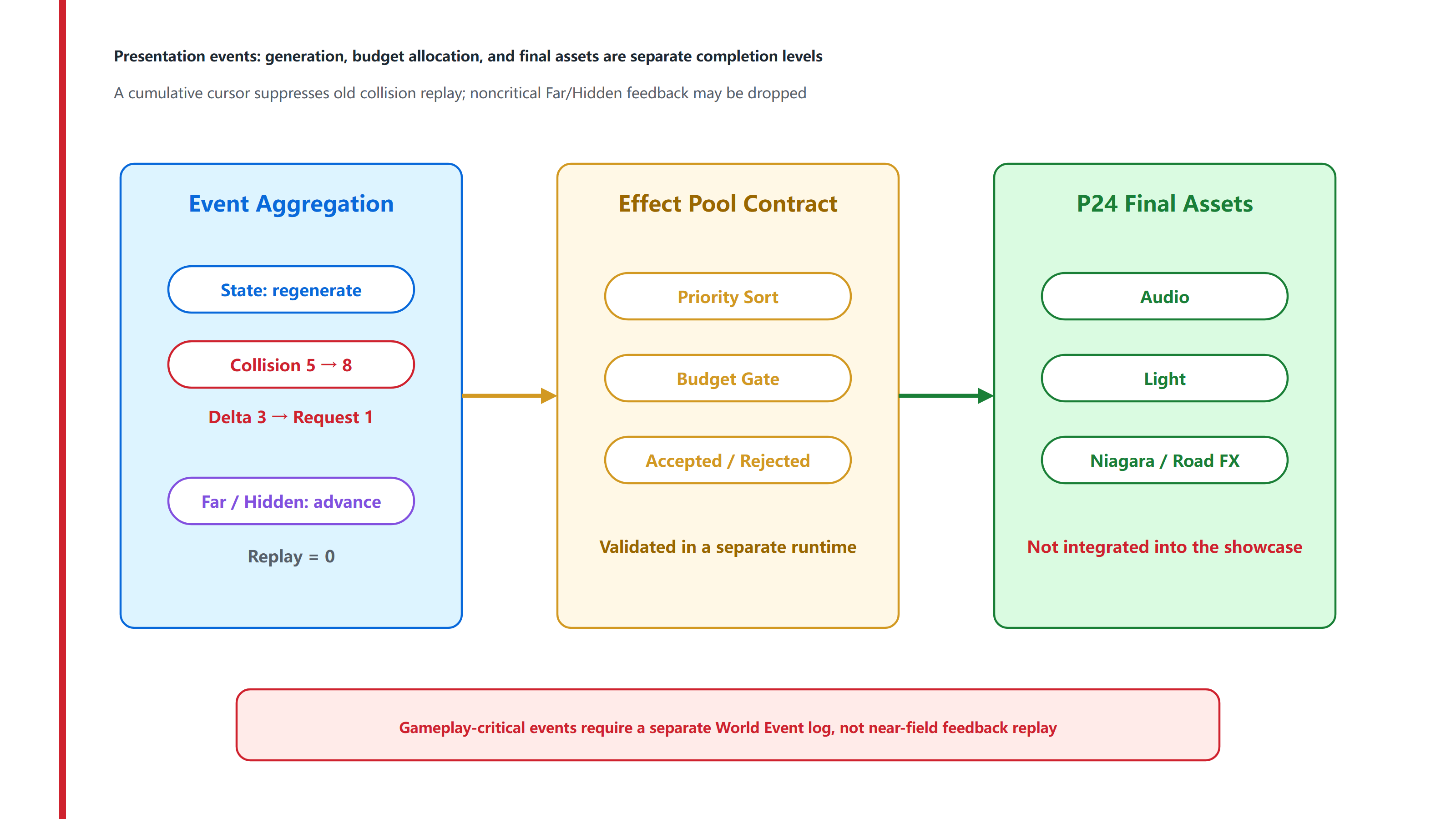
Event aggregation stores the last observed collision count for every VehicleId. A Near vehicle creates a CollisionImpact request only when its current cumulative count exceeds the stored value, after which the cursor advances. Multiple increments in one fixed step merge into one presentation request. Far and Hidden also advance the cursor, so promoting later does not replay impacts that happened out of range.
LastCollisionEventCountByVehicle is part of the checkpoint. Without it, a restore would forget consumption state and treat old collisions as new. This is edge detection and coalescing over a cumulative counter. It is not per-event exactly-once delivery with distinct EventIds, timestamps, and consumer cursors.
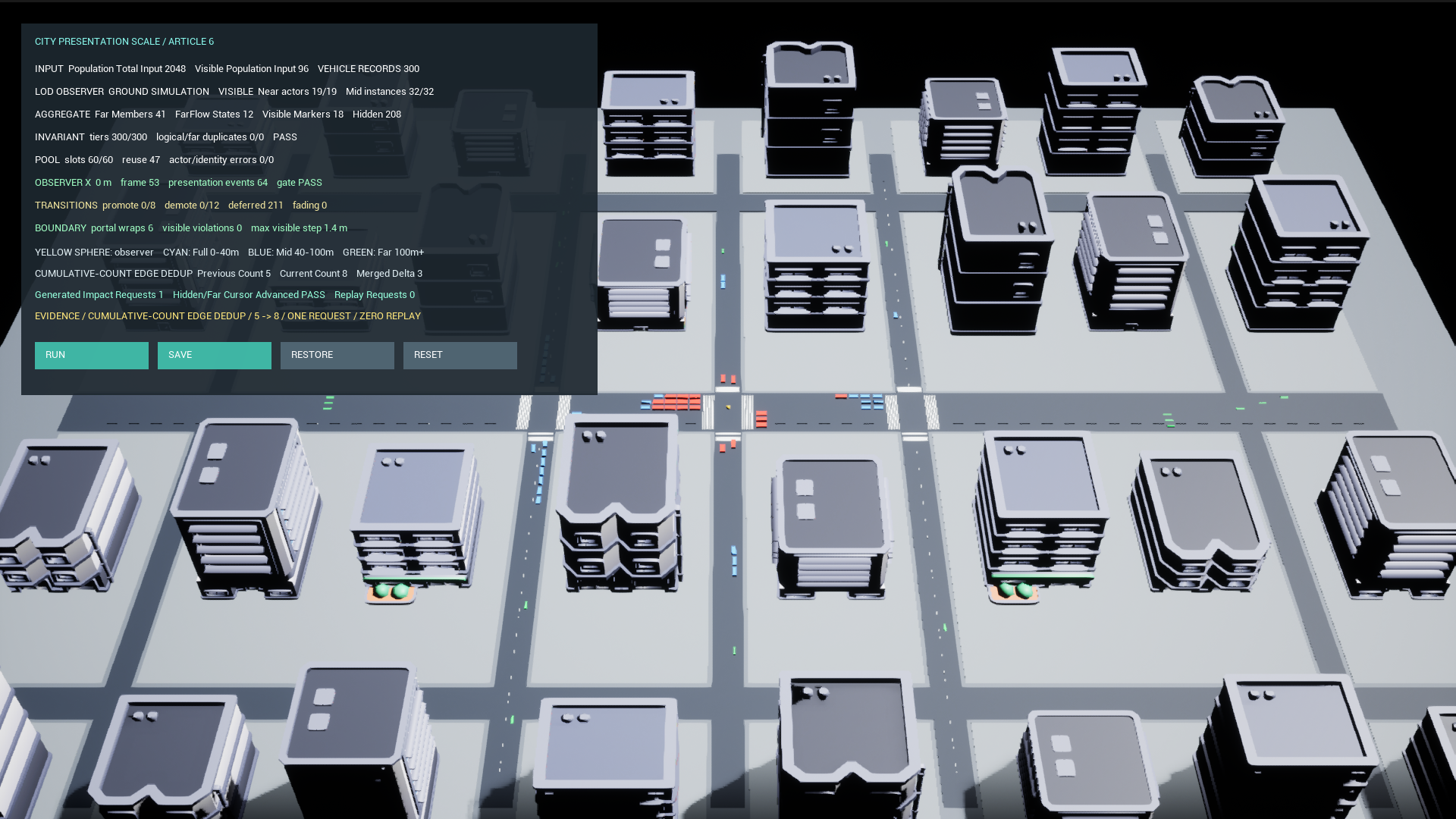
Evidence note: The cumulative collision count changes from 5 to 8. Delta 3 is coalesced into one near-field request in this step and Replay remains 0. This is cumulative-counter edge detection and deduplication, not exactly-once consumption for individual EventIds.
Why FarFlow still keeps a member list.
An average alpha and vehicle count can draw a flow band, but cannot promote a specific identity. As the observer approaches, allocation needs to know which stable VehicleIds occupy that lane and each vehicle's current progress and direction. FarFlow therefore combines aggregate statistics with a member ledger.
The renderer still does not process every member as an object. It samples representative positions while logic updates up to 48 Far identities. A production tier farther away could collapse those into anonymous density and recreate stable entities through regional traffic orchestration on re-entry. P12 stops at identity-preserving distant aggregation.
Every aggregate field needs a clear source.
Min/Max/Average Alpha are measured from member progress. Density comes from member count divided by 12. Average Speed is a fixture interpolation from a fixed Congestion Scale, not an average of 300 real vehicle velocities. Visible flow markers use concrete member directions. The aggregate Direction field still has a default-zero initialization bias in the current source and is not a reliable lane-level value until it receives an explicit member or lane fallback.
After P9/P11 integration, average speed and congestion should come from the actual Traffic Fleet, and density should account for lane length and vehicle envelopes. Keeping provenance visible prevents a plausible art-tuning number from being mistaken for measured traffic state.
Request generation, the pool contract, and final assets are three completion levels.
Event Aggregation in the showcase creates and counts structured requests. A separate Effect Pool Runtime has validated category budgets, stable priority sorting, allocation, and rejection for Audio, Light, and Road Effect requests. The usual path groups by type, sorts by Priority, OwnerId, and EffectType, updates an existing owner/type slot first, then uses an empty slot or evicts lower-priority work when policy allows.
The showcase does not yet realize every request as final audio, lighting, or road FX. Demand in one step may exceed available resources. A Near collision can outrank an engine loop, a critical brake light can outrank background tire feedback, and FarFlow may keep only a few ambience beds. Rejected requests belong in diagnostics; producers must not compensate by creating unlimited UObject or AudioComponent instances. P18 decides what each tier should express, and P24 integrates production assets and platform tuning.
| Layer | Current status |
|---|---|
| Event Aggregation | Showcase generates and counts structured requests |
| Effect Pool Runtime | Separate runtime and automation validate budget, sort, allocate, and reject contracts |
| Final visible / audible assets | Not complete; production audio, lights, Niagara, tires, and impact FX remain for P24 |
Suppressing a Hidden effect still advances its cursor.
If a Hidden vehicle records a collision, no visible or audible impact request is created, but Last Collision Count still advances. This deliberately discards distant feedback instead of delaying it until promotion.
A mission-critical crash that the player must learn about later belongs in a separate Gameplay or World Event log. Presentation deduplication and gameplay-event persistence are different contracts.
6. Long runs, checkpoint restore, and the completion boundary
6.1 Visible vehicles cannot teleport at route endpoints
All 300 logical vehicles loop at route endpoints, where lane alpha returns from nearly 1 to 0. A visible vehicle crossing the end of the 520 m avenue would otherwise teleport across the scene. P12 defines hidden and fade-in regions at both ends: scale falls to zero near the seam and returns only inside the safe region.
Each step retains previous position and endpoint scale. A displacement over 100 m counts as a portal wrap. If either side remains visibly above the threshold, VisiblePortalViolationCount increments. Maximum ordinary visible displacement is tracked separately. The accelerated 30-minute soak requires zero visible wrap violations.
This seam treatment belongs to a closed test route. It is not an open-world streaming solution. A real city needs a road graph, region gates, and handoffs to neighboring regions. P12 only keeps a logical route loop from appearing on screen.
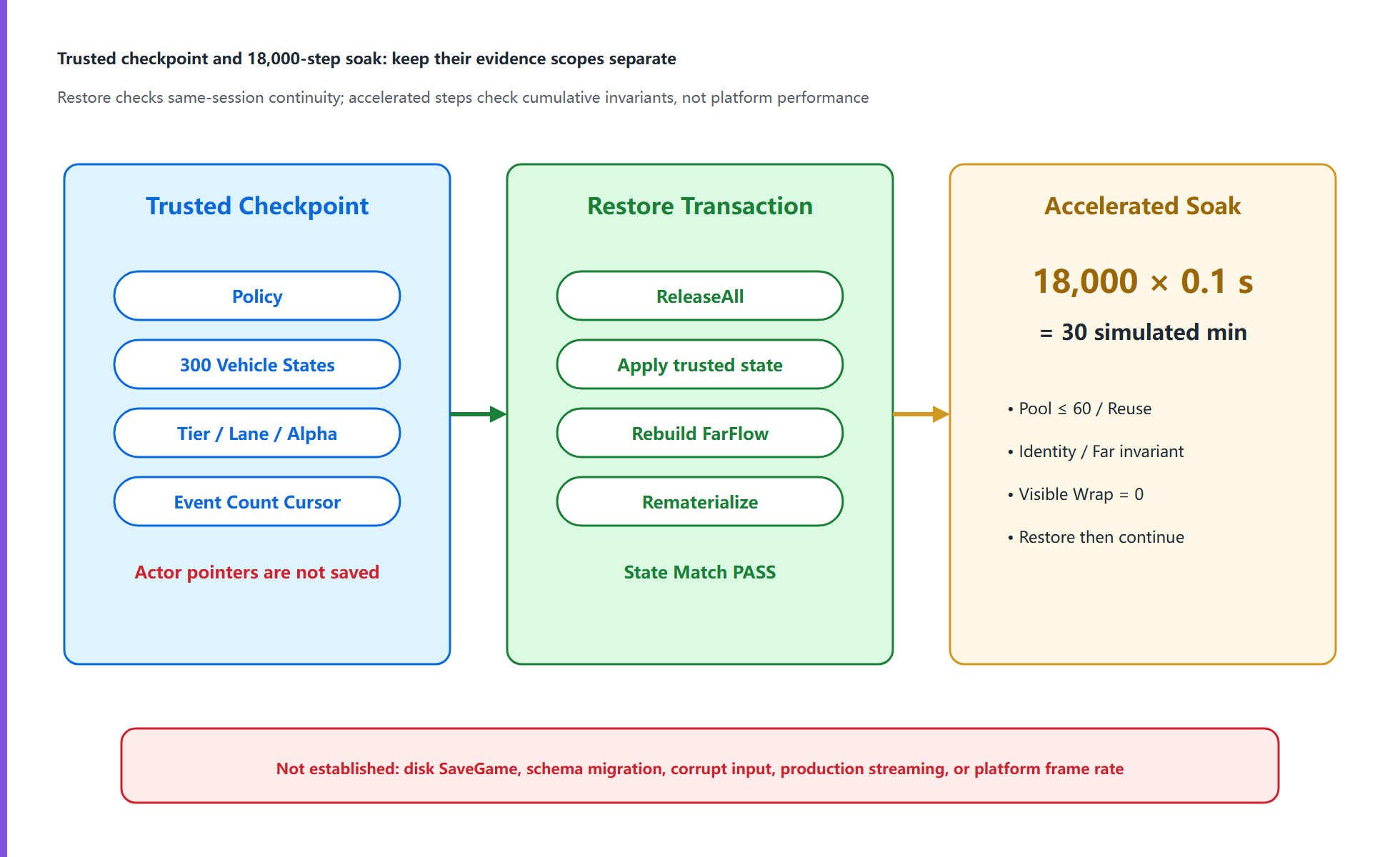
6.2 A checkpoint saves logical presentation state, not Actor pointers
The P12 checkpoint contains:
- the complete tier policy and budgets;
- all 300 vehicle IDs, lanes, progress values, positions, headings, tiers, and visibility values;
- current FarFlow aggregates and members;
- presentation-event deduplication state;
- fixed-step, observer, transition, wrap, and diagnostic counters.
Actor-pool bindings and Actor pointers are not saved. Restore first releases all materialized representations, writes back logical and aggregation state, and clears the fixed-step accumulator. The next step reacquires resources according to the restored tiers. This checks that identity and representation intent survive while Actors remain rebuildable caches.
The controls expose PAUSE / RUN / SAVE / RESTORE / RESET. After restore, frame number returns to the checkpoint, all 300 identities remain stable, and resumed execution must not create duplicate Actors or FarFlow identity errors. Restore count increments independently rather than rolling back to the saved value.
Why restore releases everything first.
The checkpoint tiers describe representation intent at save time. The live pool may have completed many handoffs since then. Writing old logical state over current bindings could leave an Actor owned by a later VehicleId while the restored map claims a different owner.
ApplySnapshot therefore calls ReleaseAll, restores Policy, Presentation, Event Aggregation, and Status, then lets the next fixed step materialize by restored VehicleId and Tier. Actor addresses may change; LaneId, alpha, tier, and event cursors must match.
Restore accepts only a trusted in-memory checkpoint produced by this demo session. Before apply it checks basic configuration and the 300-record count, but it does not yet fully validate VehicleId uniqueness, LaneId, tier/FarFlow conservation, policy legality, event-cursor references, schema, map version, or resource version. It also lacks transactional rollback for malformed input. This is not disk SaveGame support, cross-version persistence, or safe ingestion of arbitrary snapshots.
FarFlow and some diagnostics could be re-derived from per-vehicle state. They are stored now to reproduce the acceptance frame exactly. A production save would more likely restore identity, lane, progress, and required event cursors, then rebuild FarFlow. If derived state remains serialized, cross-table validation must occur before releasing current carriers.
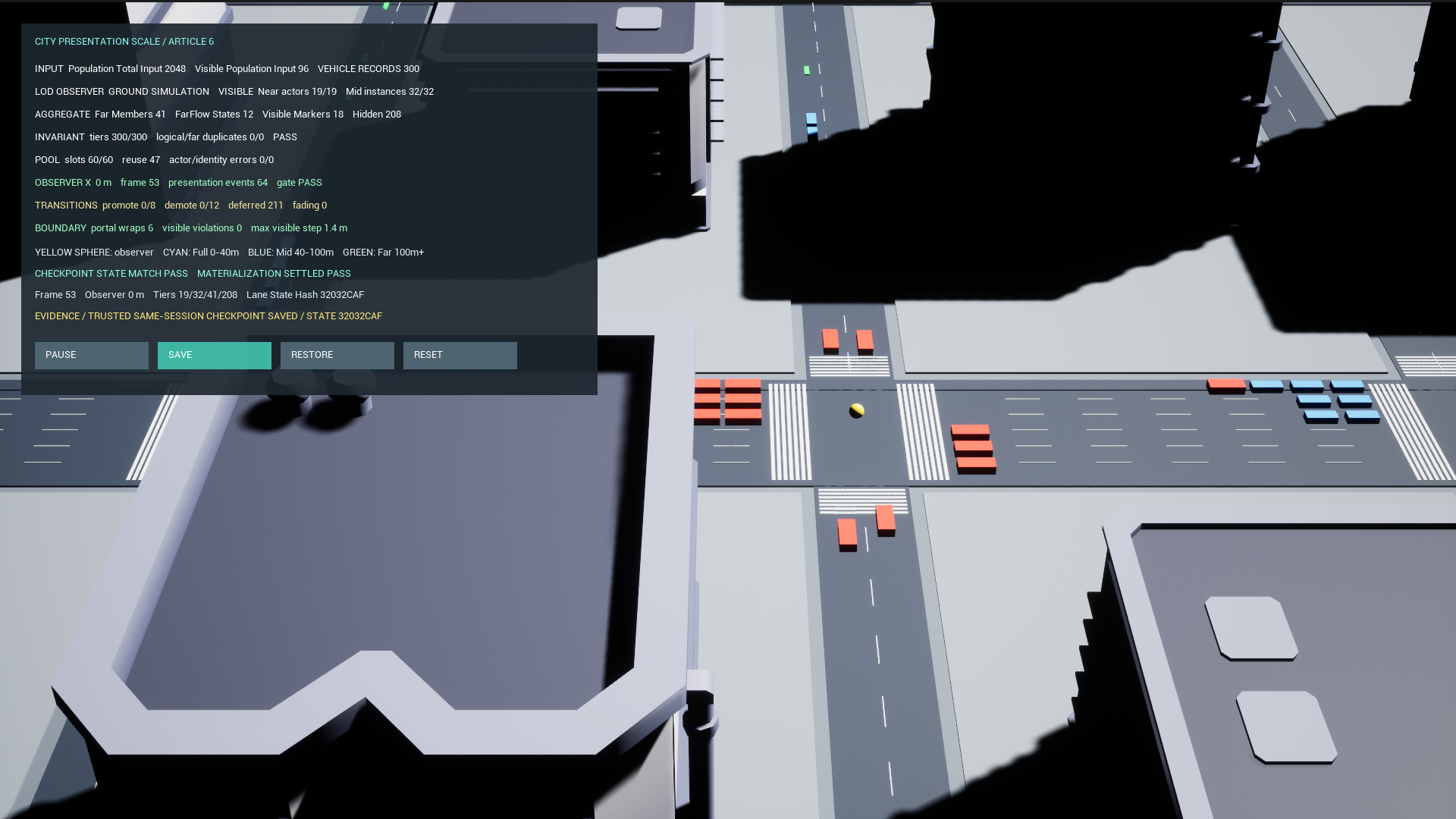
Evidence note: The checkpoint records Frame 53, tier counts 19/32/41/208, and Lane State Hash 32032CAF. This is a trusted same-session checkpoint, not a disk SaveGame.
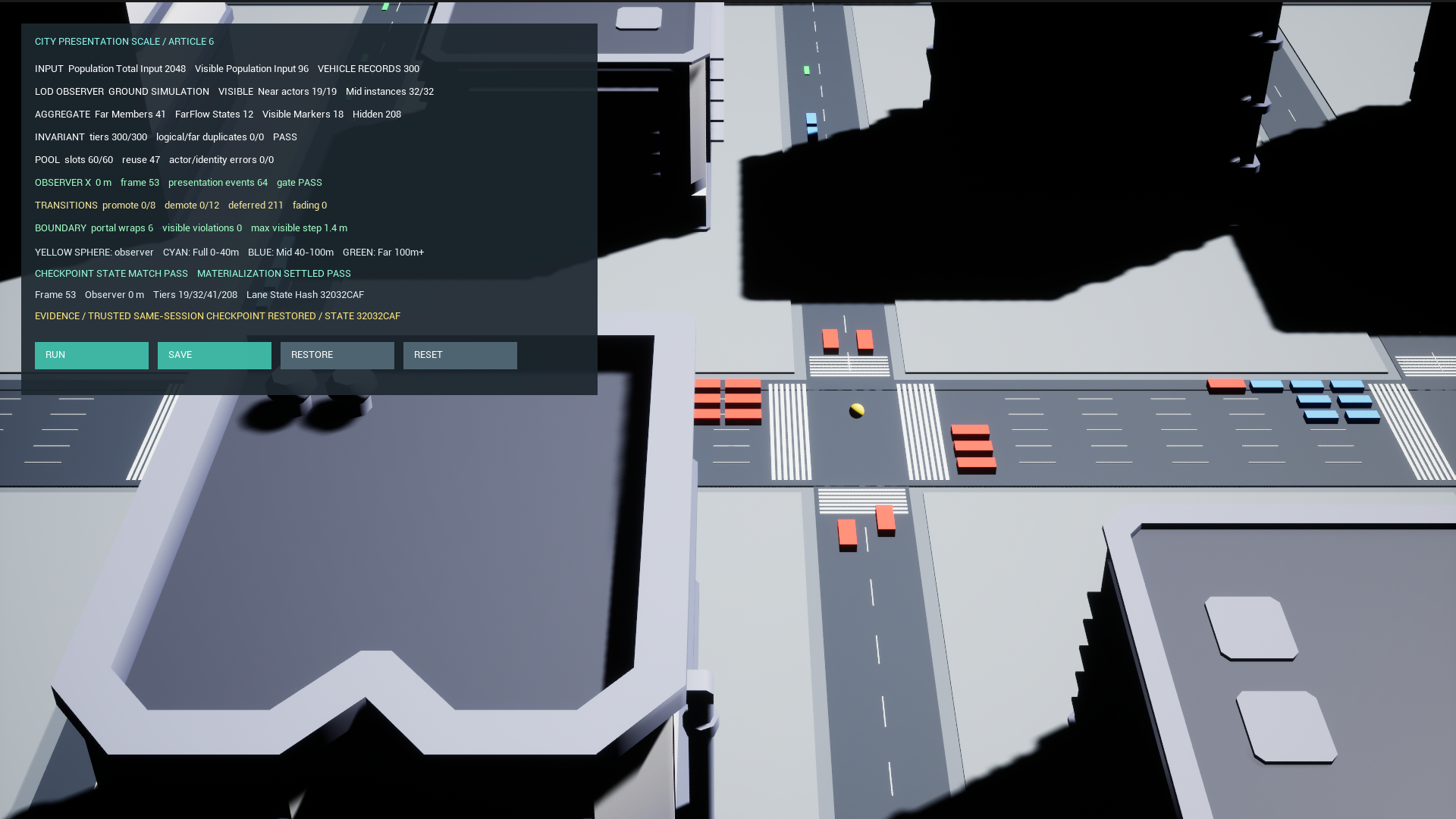
Evidence note: After restore, frame, tier counts, and Lane State Hash match the checkpoint, and both state match and rematerialization pass. Actor addresses and pool-reuse history are not required to return to their saved transient values.
The checkpoint does not save Materialization Pool reuse count or slot bindings. PoolReuseCount continues from the session's current pool after restore. The Scale Gate cares about caps, unique ownership, and continued reuse, not internal pool history. A deterministic performance replay would need separate resource-tracing data, which still should not become ordinary player-save state.
Pause freezes logical steps, not the review UI.
While paused, Tick stops accumulating and executing fixed steps. Vehicle alpha, observer position, tiers, and event cursors remain fixed, while HUD and camera controls continue responding. A reviewer can inspect one handoff state without observation changing the 300 identities or 60 slots.
Save works while running or paused. Restore preserves the pre-operation pause state: a paused restore stays paused, while a running restore resumes advance. Control state remains separate from simulation state.
6.3 What the Scale Gate checks
The immediate gate requires:
- 300 vehicle-presentation records, plus aggregate population inputs 2,048 and 96;
- Near, Mid, and Far at or below
24 / 36 / 48; - at least one Hidden identity;
- maximum Near distance inside its exit threshold;
- no more than
8 / 12promotions and demotions per step; - at least one non-Hidden representation on every active route;
- no more than 60 materialization slots and unique current bindings;
- visible FarFlow markers;
- zero duplicate Actors, identity errors, and visible route-wrap violations.
Long-loop evidence separately requires PoolReuseCount to grow while total Actor slots remain fixed. Reuse need not have occurred on the first frame, so it is not folded into the immediate gate.
Automation covers presentation quality, materialization, event aggregation, the compact regression map, the city showcase, and soak behavior. The accelerated soak advances 18,000 fixed steps at 0.1 seconds each—about 30 minutes of simulated time—and audits ownership, restore-and-resume behavior, and route seams throughout.
The 30-minute soak targets cumulative faults.
A short clip proves that Near, Mid, and Far can coexist but is unlikely to expose slow leakage. If one stale Actor survives occasionally, the pool may stay below 60 for several minutes and grow only after many observer loops. Duplicate Far members and visible endpoint wraps can also appear only after repeated cycles.
Every soak interval audits pool cap, unique Actor ownership, unique VehicleId, FarFlow member conservation, visible endpoint violations, continued execution after restore, and the Scale Gate. Collision-counter deduplication is covered mainly by the focused Event Aggregation test and valid checkpoint restore. The showcase soak does not inject a continuous sequence of real visible collisions and cannot establish per-event consumption by itself.
Accelerated simulation is not a platform-performance or complete persistence test. Passing it does not mean the target platform can render the scene in real time for thirty minutes, nor does it rule out process- or asset-loading memory leaks. Production vehicles, animation, audio, Niagara, World Partition, asynchronous streaming, region handoff, corrupt snapshots, and every one-shot event ordering are outside this pass.
A passing gate does not mean the configuration is optimal.
The 24/36/48 budgets and 40/50/100/260/320 m distances are working fixture parameters. Platform, camera height, vehicle assets, and city density will change them. Production tuning needs separate measurements for:
- Near Actor count against Game Thread, animation, and physics cost;
- Mid instance count against submission and GPU visibility;
- FarFlow count, width, and speed against distant readability;
- promotion/demotion spikes against spawn, component registration, and streaming;
- rejection rates in audio, light, and road-effect pools;
- Deferred Transition duration under fast cameras.
Only stable module profiles and visual A/B tests can turn demo constants into platform settings.
6.4 What is established—and what is not
Established:
- 300 logical vehicles continue moving outside a fixed 60-slot materialization pool;
- Near, Mid, Far, and Hidden budgets, hysteresis where implemented, and per-step transition caps are active;
VehicleId, lane, and progress remain continuous across tiers;- Far and Hidden require no per-vehicle Actor;
- distant members aggregate into a limited set of lane flow markers;
- presentation requests are decoupled from motion, and cumulative collision counts suppress old feedback replay;
- a trusted same-session checkpoint rebuilds representation without duplicating identity;
- visible endpoint teleports remain at zero over long loops.
Not established:
- production vehicle meshes, materials, wheels, lights, and damage parts;
- final GPU impostor, Nanite/instance strategy, or platform rendering budget;
- complete engine, tire, congestion, horn, and crowd sound fields;
- Niagara distant light bands, weather, wet reflection, or night integration;
- final visible allocation and animation cost for 2,048 pedestrians in the same map;
- suitability of this automatic-observer policy for player cameras, chase shots, or aerial views;
- direct reuse of blockout transition distances for production assets.
P12 closes the first UE5 logic-prototype stage. It demonstrates that the city-scale relationships can hold in code without pretending that tiered blockouts are a finished city. P18 will define what crowds, vehicles, traffic, and the environment should communicate at each viewing scale. P24 will then integrate production assets through UE5-native systems and perform L2 platform tuning.
| Part | Owns | Does not own |
|---|---|---|
| P12 | VehicleId, Tier, Visibility, pool ownership, Far members, event requests, checkpoint, acceptance gate |
Final visual technique or platform budget |
| P18 | Visual information by tier, transition feel, camera priority, light bands, point fields, soundscape, Niagara | Vehicle identity, routes, or pool contract |
| P24 | Production vehicles, GPU/instance implementation, Audio/FX pools, profiles, final distances and budgets | Hiding duplicate identity, event replay, or slot leakage behind better assets |
The next stage should consume P12, not reimplement it.
P18 can choose full Near assets, skeletal reduction, static instances or impostors for Mid, and light bands, points, Niagara, or GPU buffers for FarFlow. Hidden may feed ambience statistics. Whatever the visual technique, it should consume the current VehicleId / LaneId / LaneAlpha / Tier / Visibility / Event Request contract instead of taking ownership of identity, route advance, or pooling.
P24 can replace cubes and flow bars with production meshes, materials, wheels, Audio/FX pools, GPU instances, or impostors, then integrate World Partition, streaming, and platform budgets. If the replacement makes the pool exceed 60, duplicates identity, or replays old collisions after restore, presentation integration has broken the runtime contract. If the contract holds but traffic looks sparse or transitions are obvious, the problem belongs to presentation policy or asset quality. Keeping those failure classes separate is the point of the 6+6+6+6 development structure.
Conclusion: Scale comes from selective materialization
City life is not another name for Actor count. Three hundred logical vehicles can share sixty Near/Mid slots. Distant roads keep direction and density through a small set of lane aggregates. Hidden identities continue to advance. As the observer moves, carriers relay between identities. On restore, identity and progress return while Actors rematerialize. The event layer consumes only the presentation requests that the current budget can support.
This structure is not a one-to-one copy of the source tiers. The source deliberately anonymizes traffic farther away; P12 keeps identity in FarFlow because handoff behavior is what this prototype needs to test. Both point to the same rule: identity, motion, representation, and effect budgets need separate ownership. A full vehicle entity cannot be the only carrier of city traffic.
P7–P12 now provide a first runnable UE5 pass over six low-level logic topics. They answer whether the system relationships can work. The next stage must decide which visual information survives at each viewing scale and define measurable acceptance criteria for production assets, instead of adding more blockout proxies.
AI Collaboration Review
- Where AI helped: comparing the P6 source analysis with the P12 city-presentation runtime, materialization pool, Far aggregation, event requests, and acceptance notes; separating logical identities, aggregate members, Actor slots, and actual instances into distinct ledgers.
- Where people still decide: artists, technical artists, audio designers, and performance engineers must choose Near/Mid/Far assets, transition methods, and platform budgets. Temporary blocks and lane bars validate structure only.
- How the claims were checked: fixture dimensions, logical scale, budgets, route count, observer path, and soak length come from the running map and P12 baseline. Pool and event boundaries come from C++. The source's anonymous distant traffic comes from the P6 code-reading evidence.
- Scope of this article: this is a UE5 logic demo for city-scale representation allocation. It does not project FarFlow member IDs back onto the source implementation, or treat temporary proxies, a passing fixture, and generated requests as final rendering and audiovisual quality.