Urban Vitality · P10 · UE5 Logic Demo
P2 examined how a mature open-world runtime connects pedestrian poses, traffic slots, animation motion tables, ground alignment, and group response. This article turns to our UE5 reconstruction: a runnable prototype built around a fixed-step SoA, a pedestrian-space graph, explicit crosswalk state, groups, avoidance budgets, and a published Motion Frame. P7 remains authoritative for population identity, zones, and schedules. Production characters, animation, and materials belong to the later presentation-design and L2 implementation stages.
Analysis counterpart: Urban Vitality P2 | Pedestrian Motion in an Open World
Introduction: Pedestrian motion starts with data continuity, not animation
Spawning Characters, sending them through navigation, and playing a walk loop produces moving people quickly, but leaves four runtime responsibilities without an owner: preserving position when no full character exists, interlocking crosswalk waits with vehicles, bounding work under crowd pressure, and publishing authoritative state for the animation graph.
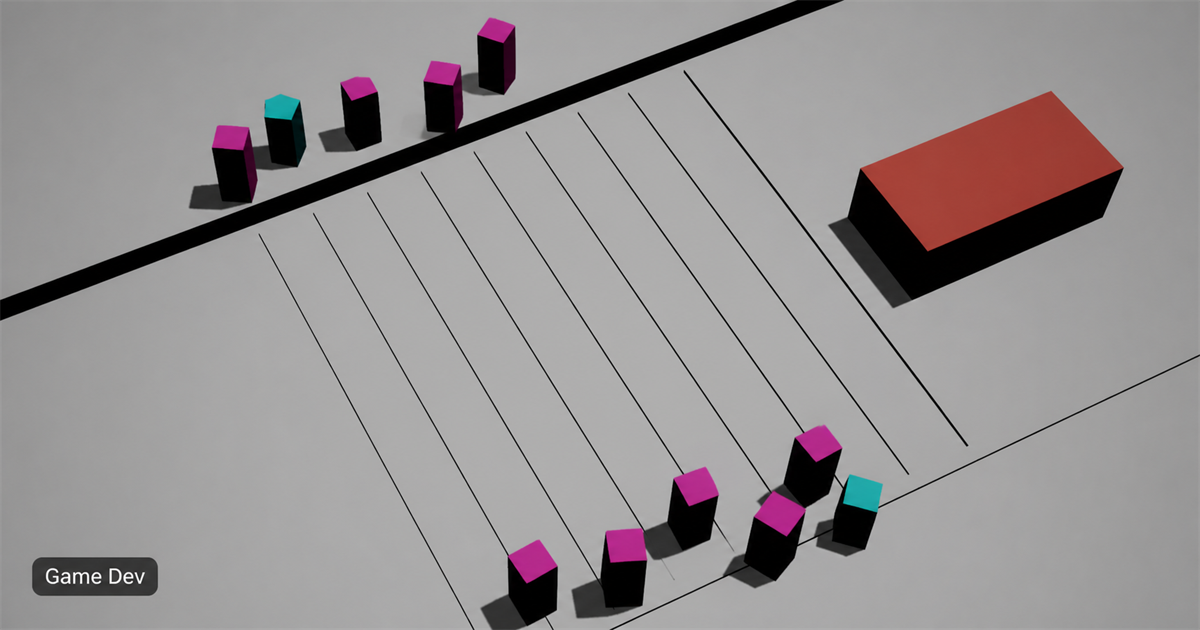
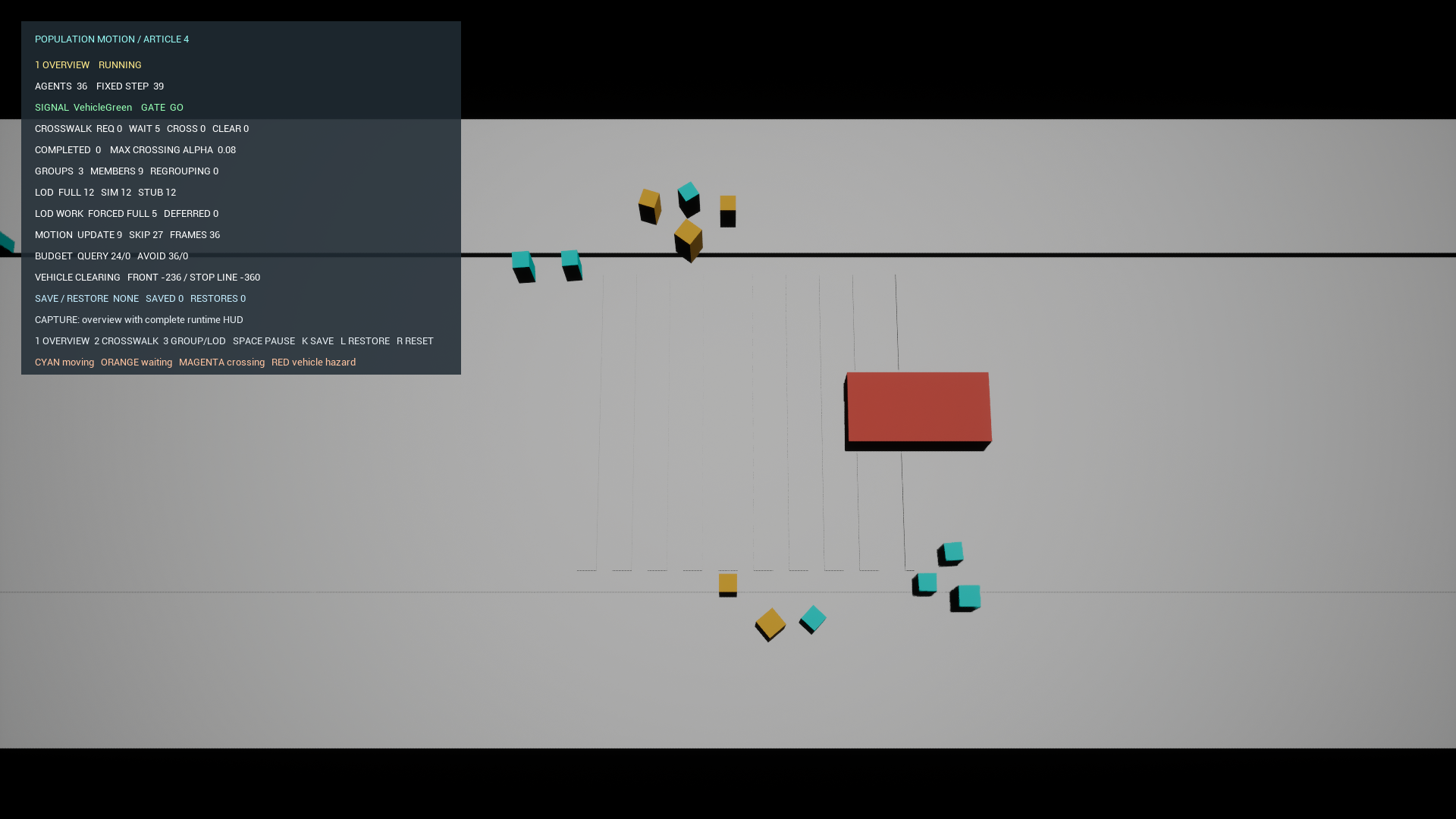
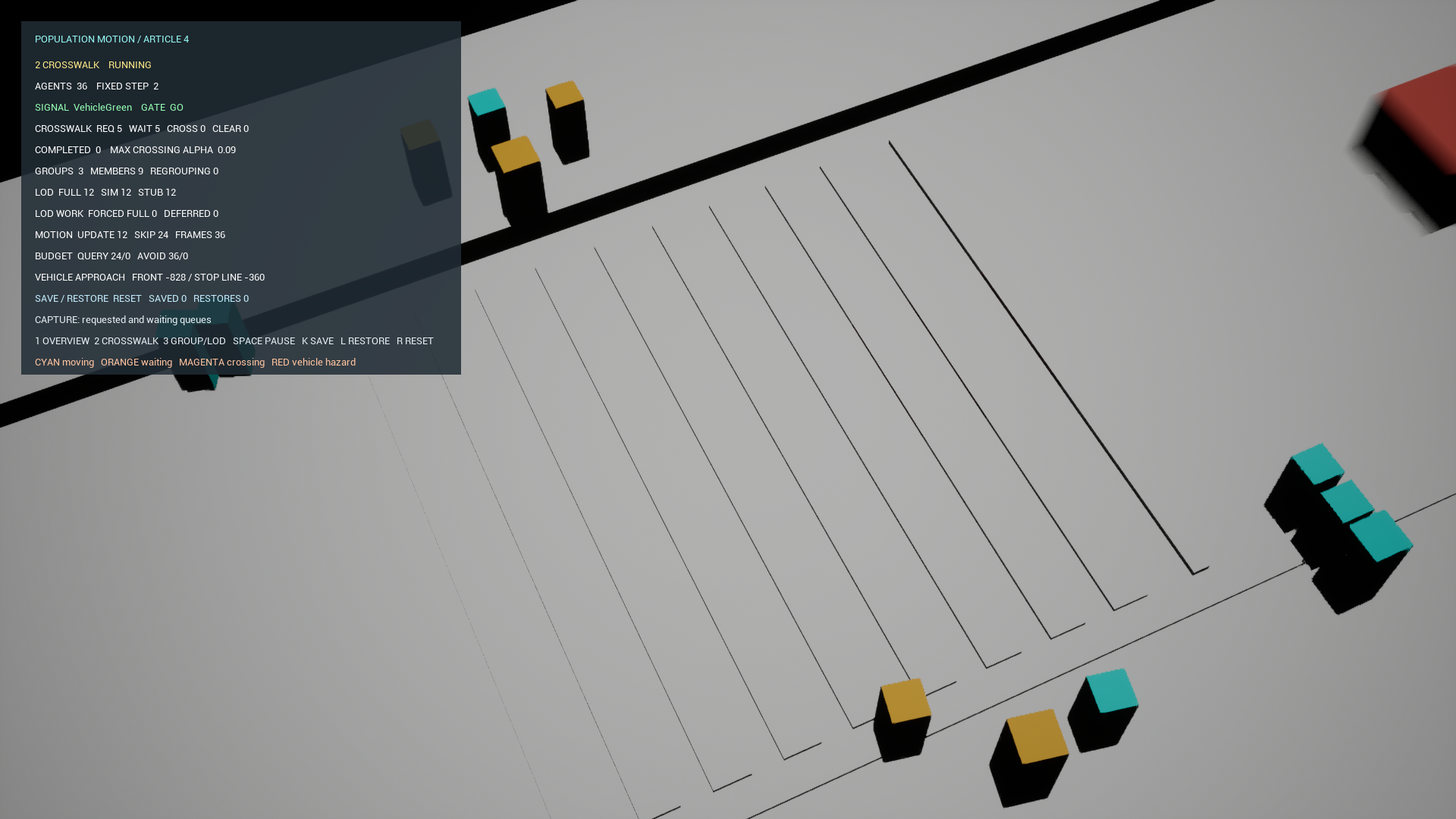
The P10 acceptance demo renders pedestrians as temporary boxes. The default route joins a west sidewalk, a crosswalk connector, and an east sidewalk. Agents travel continuously along bidirectional ping-pong routes. A red box represents a vehicle hazard that loops past the crossing. Cyan means ordinary motion, orange means requested or waiting, and magenta means crossing or clearing. Box size indicates presentation tier, never a different identity.
The map is not evidence of finished character animation. It tests whether the following data path remains coherent:
| Observation | HUD evidence | Runtime contract |
|---|---|---|
| Complete crossing cycle | Requested / Waiting / Crossing / Clearing / Completed | State, signal, and conflict occupancy stay synchronized |
| Group motion | Groups / Members / Regrouping | Leader, formation slot, and shared crossing phase |
| Camera movement | Full / Simulated / Stub | Each Agent changes tier without changing identity |
| Fixed-step load | Motion Updated / Skipped | Stable hashes spread 1/2/8-step cadence |
| Query budgets | Crosswalk / Avoidance Processed / Deferred | Work is bounded; unfinished jobs may continue later |
| Save / Restore | Route, state, and tier continue | Ephemeral boxes are rebuilt instead of serialized |
1. From the source runtime to UE5: separate motion truth from presentation
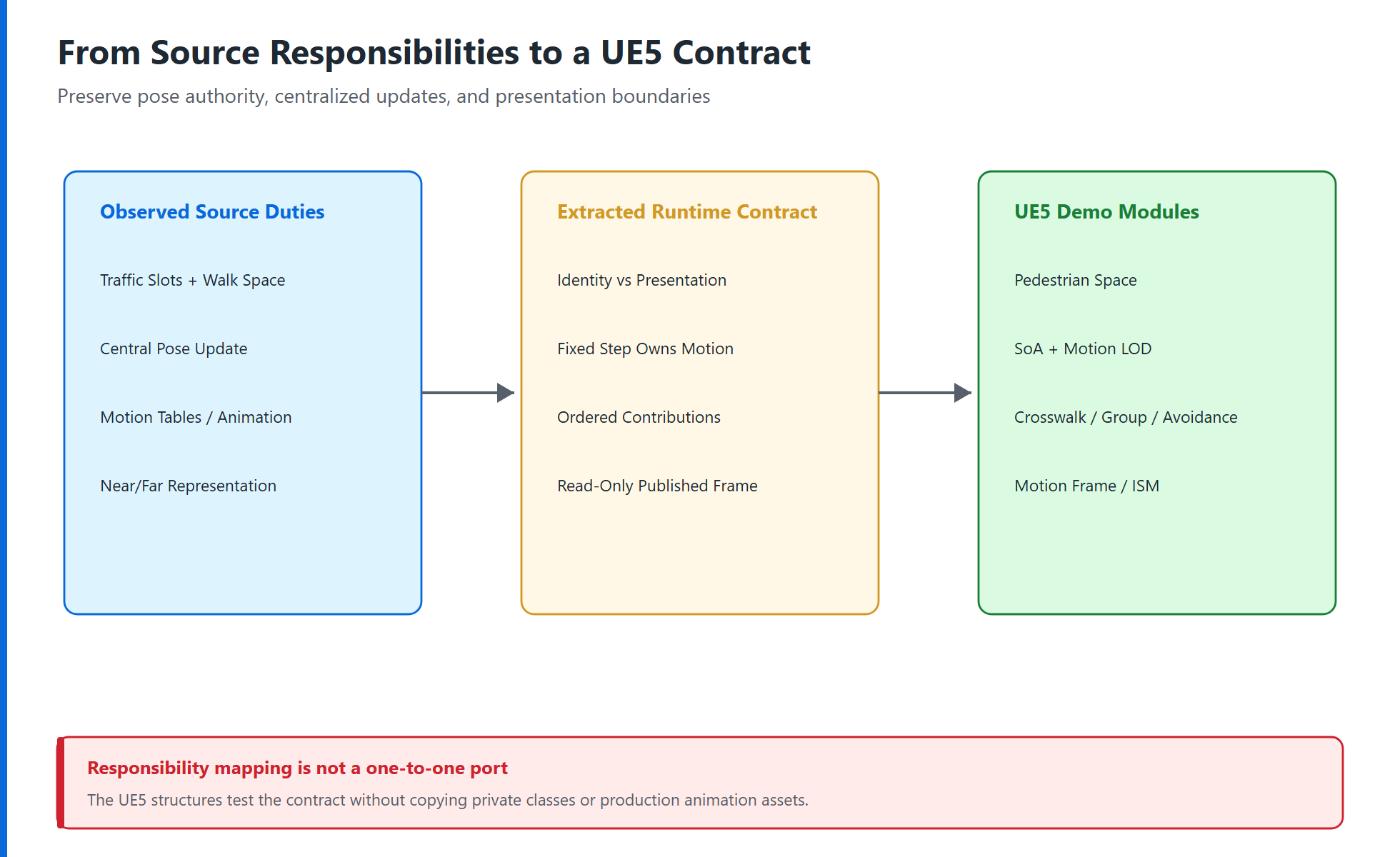
Pedestrians in the source runtime do not all depend on autonomous ticking by full character Actors. Traffic-lane slots provide spatial and motion context. A centralized update produces target transforms, motion tables select clips from speed, turning, and behavior, and later stages consume those results for character presentation, ground alignment, and collision prediction. Near entities can receive richer animation and interaction while distant crowds take a lighter data and rendering path.
The source runtime keeps these responsibilities separate. A traffic slot is not an entity. An animation clip is not the authority for displacement. Anonymous distant dots do not own stable identity. Accepting a movement or spawn request does not mean that a character is already attached to the world. Pedestrians and vehicles may share road topology and conflict space, but they do not share one motion model.
Our P10 reconstruction uses project-owned runtime code rather than Mass, MassTraffic, or ZoneGraph. It does not reproduce the original animation database, entity slots, or distant-dot renderer. It preserves six contracts instead:
- AgentId and route state survive temporary presentation changes.
- Batched motion lives in an SoA and advances on one fixed-step clock.
- Sidewalks and crosswalk connections have explicit topology.
- Vehicle hazards, pedestrian separation, and group constraints compose as data contributions.
- Crossing is a saveable state machine, not an inference made by animation.
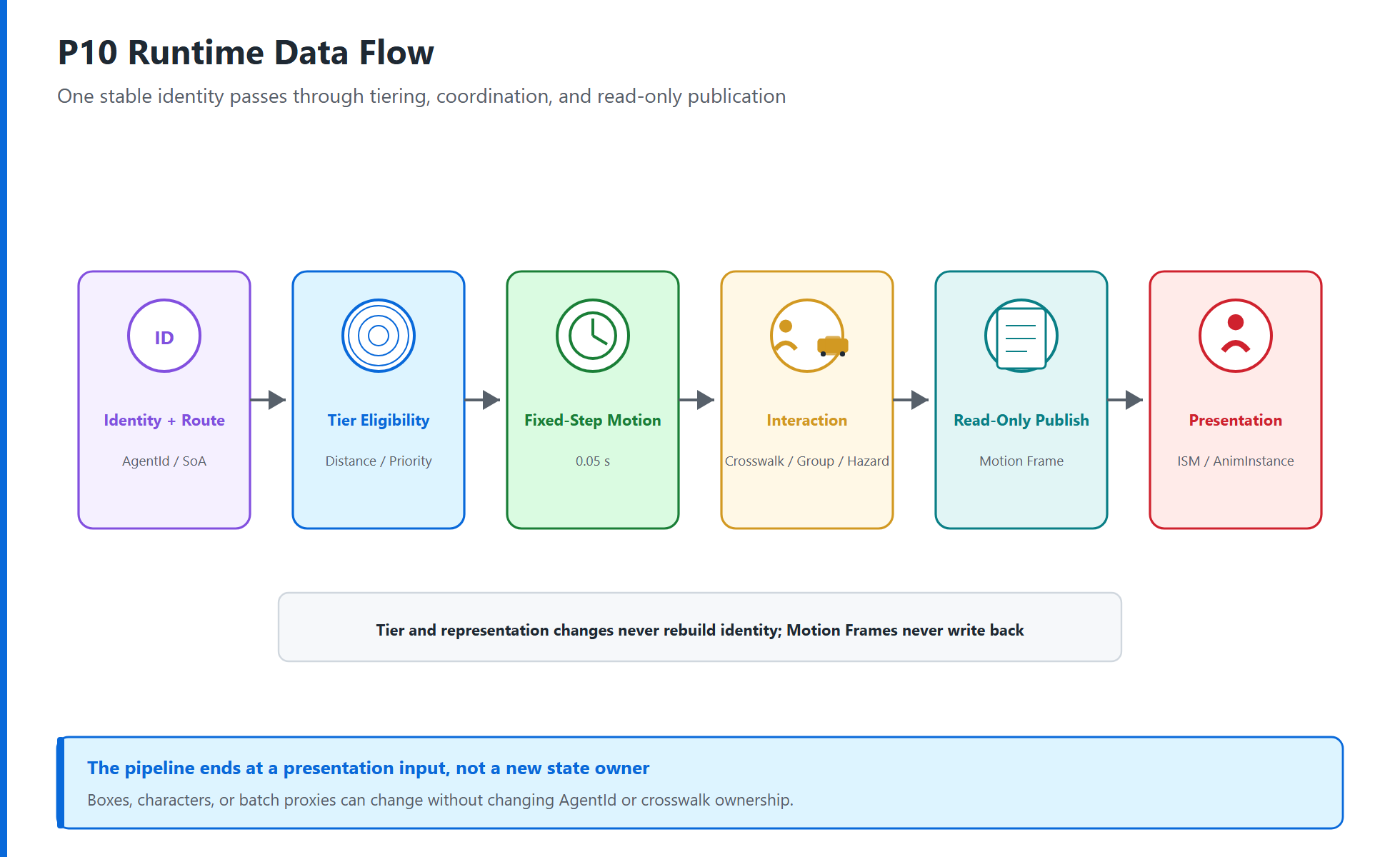
- Every identity publishes one Motion Frame that presentation can only read.
Pedestrian space in the demo
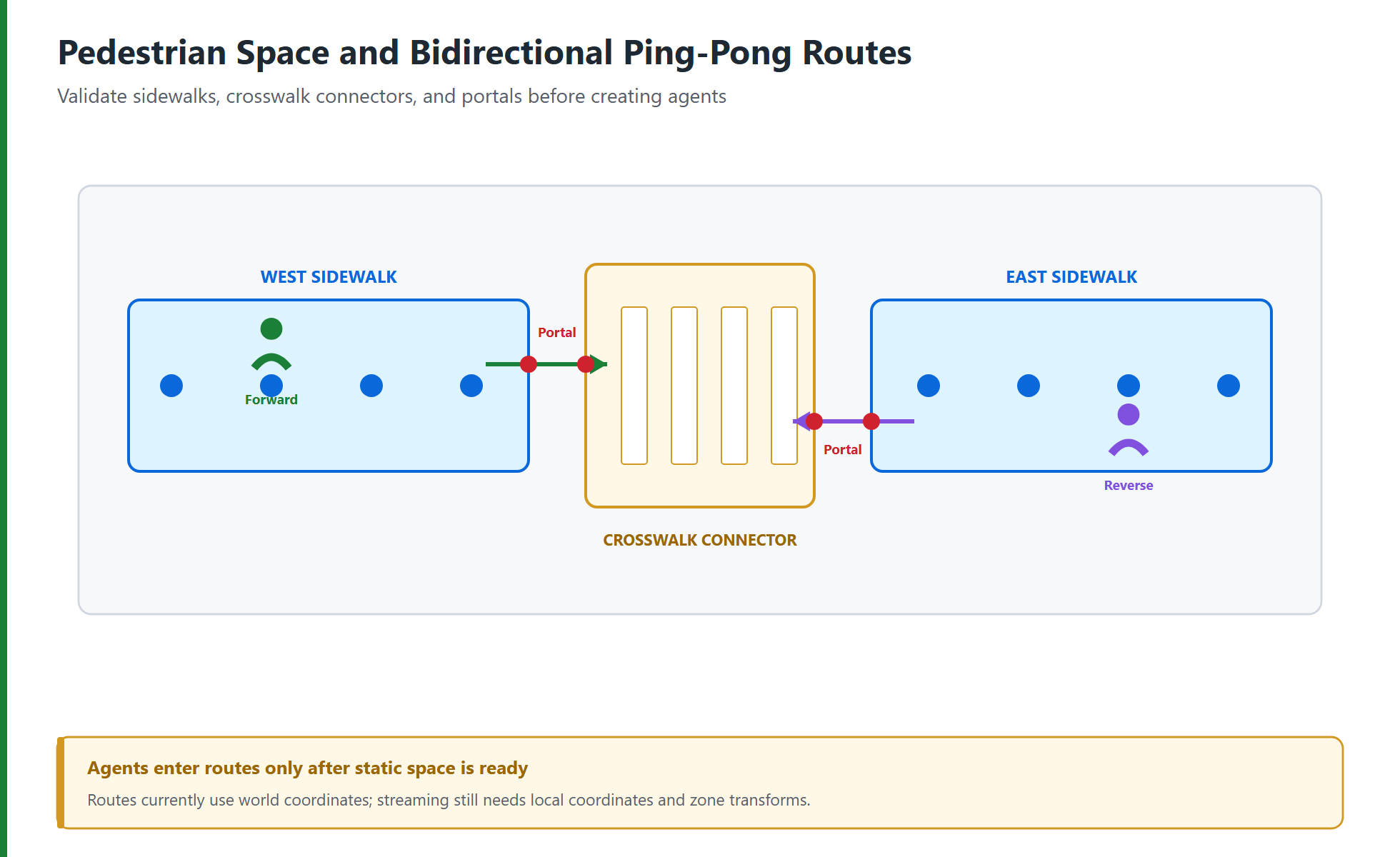
Configuration creates three logical routes—a west sidewalk, a crosswalk connector, and an east sidewalk—and four portal links. FCyberPedestrianSpaceRuntime::BuildFromRouteGraph converts the route points into queryable nodes and segments, then validates the result immediately. The demo does not start if construction or validation fails.
The default crosswalk places its waiting points at (0,-350) and (0,350). Each pedestrian route contains six points: approach from one far sidewalk, stop near the waiting line, cross the road at X=0, and continue toward the opposite far side. Odd-numbered routes reverse direction. The first three lateral offsets are -25, 0, and 25 cm, while group start positions recede along the sidewalk so that every identity does not occupy the same point.
At configuration time, each route is expanded directly into a point array. The pedestrian-space graph validates topology and supports queries, but the running SoA does not perform general graph search. Motion state is connected to a spatial contract; city-scale pedestrian pathfinding remains outside the demonstrated scope.
State that animation must not own
The source pipeline first produces a target pose from a traffic slot or navigation result. Character representation, motion tables, and ground alignment consume that target afterward. A clip may control gait, turning, and foot contact, but it cannot be the sole owner of world position. Otherwise route progress disappears when the character is downgraded, animation is paused, or the entity unloads.
P10 divides state into three categories:
| State category | Examples | Authority |
|---|---|---|
| Identity and intent | AgentId, route, target point, ping-pong direction | SoA / Population Runtime |
| Space and interaction | Crosswalk phase, queue slot, group, hazard response | Motion Coordinator |
| Visible consumption | Box scale, color, future animation parameters, material | Presentation |
Presentation may interpolate a Transform or select a gait from speed. It may not modify CurrentTargetIndex or treat the end of an animation clip as proof that a crossing completed. Crossing completion comes from position relative to the assigned entry and exit; animation only makes that result readable.
Build and validate space before creating agents. The demo does not create agents first and ask each one to discover a nearby road. It builds the route graph, crosswalk, and portals, validates nodes, edges, waiting points, and signal IDs, and only then generates deterministic AgentIds and routes. Invalid static data is rejected before any pedestrian state exists. A streamed production zone should follow the same protocol: pedestrian space becomes Ready before population migration and representation requests begin.
Route coordinates and world coordinates have different responsibilities. The current fixture stores route points in world space, which is acceptable for one map. A production system should normally store zone-local or pedestrian-space-local positions and transform them into world space. That avoids rewriting thousands of persistent positions when a district moves, the origin rebases, or a streamed instance is placed elsewhere.
Regardless of storage, a Motion Frame must name its output space. P10 currently publishes world-space Location and Facing Direction, and the SoA also stores world positions. That is a known simplification, not evidence that a cross-zone coordinate protocol is complete.
2. Fixed-step SoA: one motion truth for every identity
Route data is stored by column
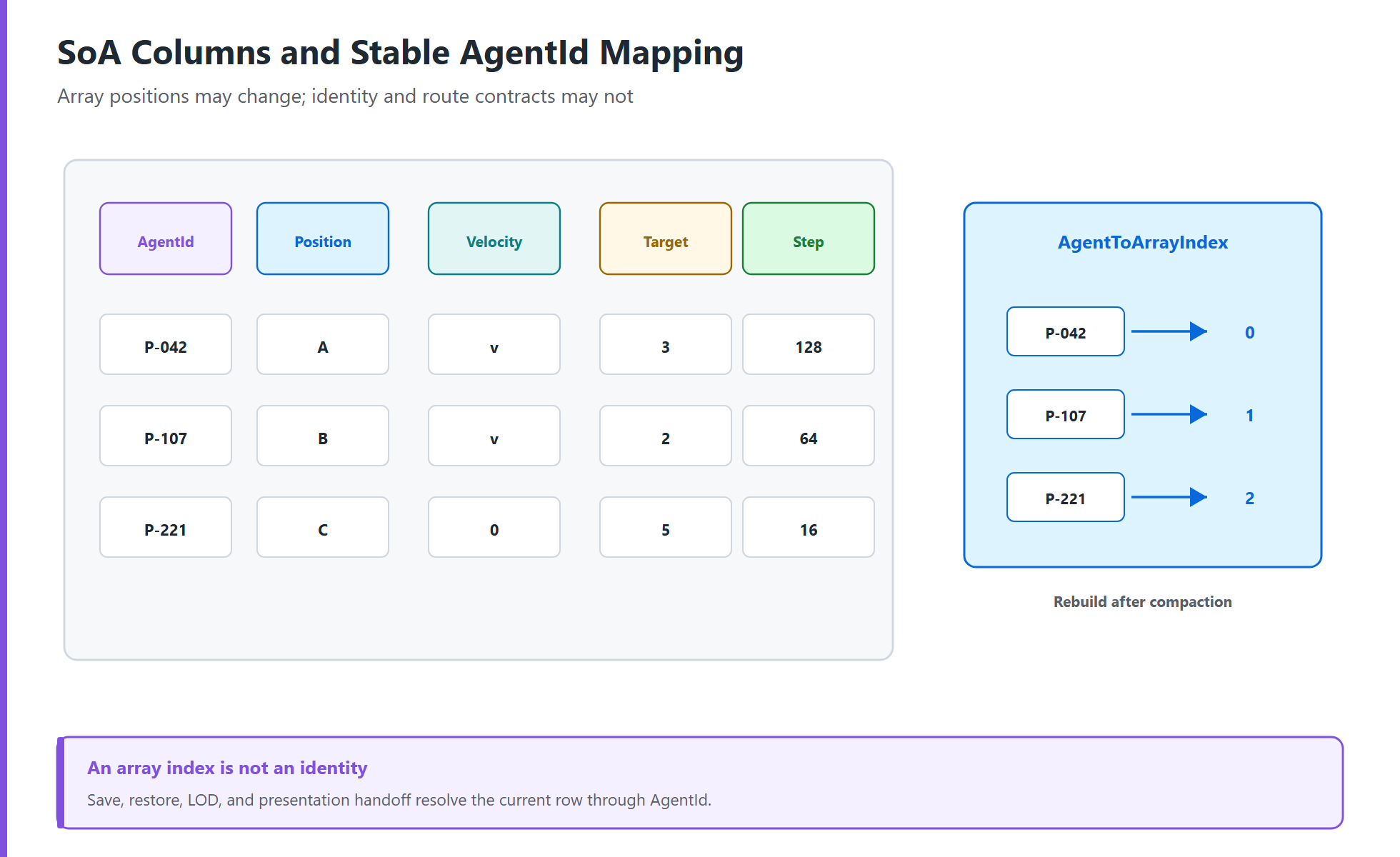
FCyberPopulationSoAState stores AgentId, Position, Velocity, Speed, CurrentTargetIndex, PingPongDirection, and AgentFixedStepCount in equal-length arrays. Route points occupy a flat array; RouteOffset and route length identify each agent's slice. AgentToArrayIndex maps a stable identity to its current row.
Default speed cycles from 105 to 141 cm/s by identifier. The first 12 identities start near the crosswalk, while the rest begin farther along their routes. The loop policy is PingPong: reaching one end reverses the target index.
The array index is not the authority. Save and restore resolve each AgentId to its current index before writing columns. Restore fails if a snapshot references an identity that no longer exists in the configured fixture. Future compact deletion must maintain AgentToArrayIndex; a presentation component must never cache a raw row number.
The fixed step builds an update mask first
Each logical step evaluates Requested Tier and Applied Tier from observer distance and LOD policy, then builds MovementUpdateFlags. AdvanceFixedStepMasked advances only marked agents and records the others as Skipped.
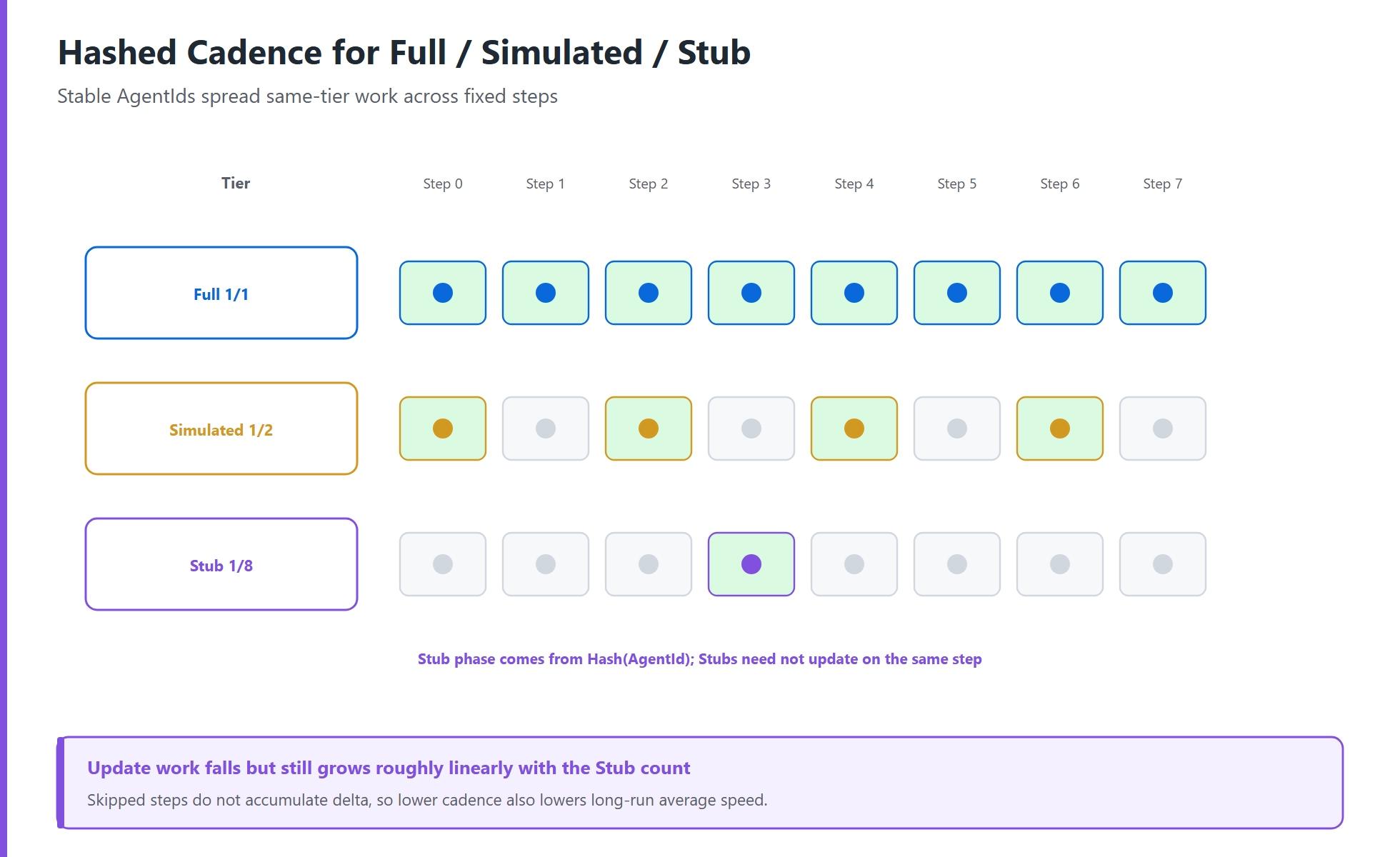
Full runs every step, Simulated every two steps, and Stub every eight. The scheduler does not place an entire tier on the same frame. It evaluates (Hash(AgentId) + SchedulerFrameIndex) % Interval, distributing work deterministically across fixed steps.
The current mask does not accumulate eight deltas for a skipped low-tier agent. When the update runs again, the function receives the ordinary DeltaSeconds; skipped agents also have Velocity cleared for that step. Stub motion therefore advances more slowly over long periods and may look intermittent. P10 covers bounded work and observable identity, but not time-equivalent motion across tiers. Production distant motion still needs accumulated time, trajectory extrapolation, or absolute arrival-time sampling.
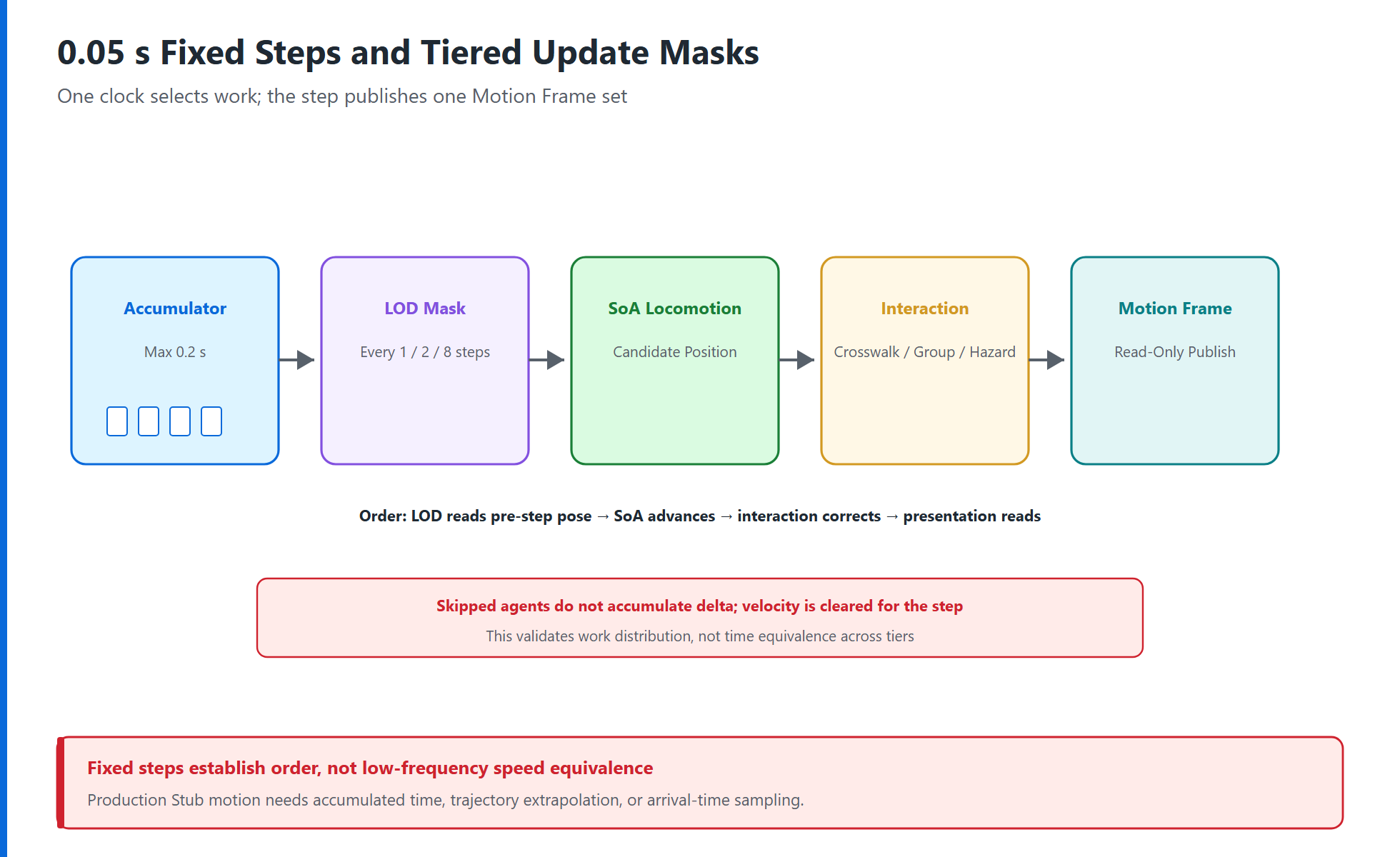
The demo uses a 0.05-second fixed step. Render-frame time enters FixedStepAccumulator, which retains at most four logical steps, or 0.2 seconds, then consumes complete 0.05-second slices. The cap prevents unbounded catch-up after a long frame, but wall-clock time beyond 0.2 seconds is lost. Acceptance proves repeatable fixed-step order, not strict wall-clock conservation after a stall.
Locomotion and interaction run in separate phases
The demo first advances route locomotion through the masked SoA, then calls AdvanceInteractionAndMotion for crosswalk state, groups, traffic hazards, local avoidance, and the final published frame. The locomotion policy caps route deviation at 65 cm so local corrections do not push pedestrians out of their path corridor.
Base locomotion proposes a position, and interaction corrects it afterward. This staged pipeline is not a continuous collision solver: a very large fixed step could cross a constraint before correction. The current 0.05-second cadence and low-speed boxes support logic acceptance but cannot replace capsule sweeps on production characters.
AgentFixedStepCount increases only when a given identity actually receives motion work. A global Scheduler Frame says how many system steps ran; it cannot prove that a Full, Simulated, or Stub agent received its intended cadence. Per-agent counts, together with Movement Updated and Skipped, expose both total work and long-term opportunity. The scheduling hash uses AgentId rather than array position, so future compaction does not change an identity's sampling phase.
Known risk in the current skipped-step model
Low-frequency motion generally needs one of three time models:
- accumulated delta, applying
8 × Deltaafter eight steps; - trajectory extrapolation between low-rate authoritative samples;
- arrival-time sampling from an absolute path interval and clock.
P10 currently skips the SoA update and later passes ordinary DeltaSeconds. Velocity is also cleared on skipped steps, so a Motion Frame can report a stationary agent even though its route remains active. This validates work distribution and state contracts. It does not validate equal average speed or continuous animation across tiers.
The implementation should define low-frequency time semantics before attaching animation. Smoothing only the visual component hides the discontinuity while logical position falls behind, producing a catch-up jump when the agent returns to Full.
Within one fixed step, LOD reads pre-step positions, the SoA advances selected agents, the coordinator reads the new positions and interaction state, and presentation consumes the completed frame set. Presentation must not read half-updated arrays. A parallel implementation will need a read-only interaction snapshot or double buffering; the present controlled sequence does not establish multithreaded race safety.
3. Crosswalk state: waiting, occupancy, and departure must be explicit
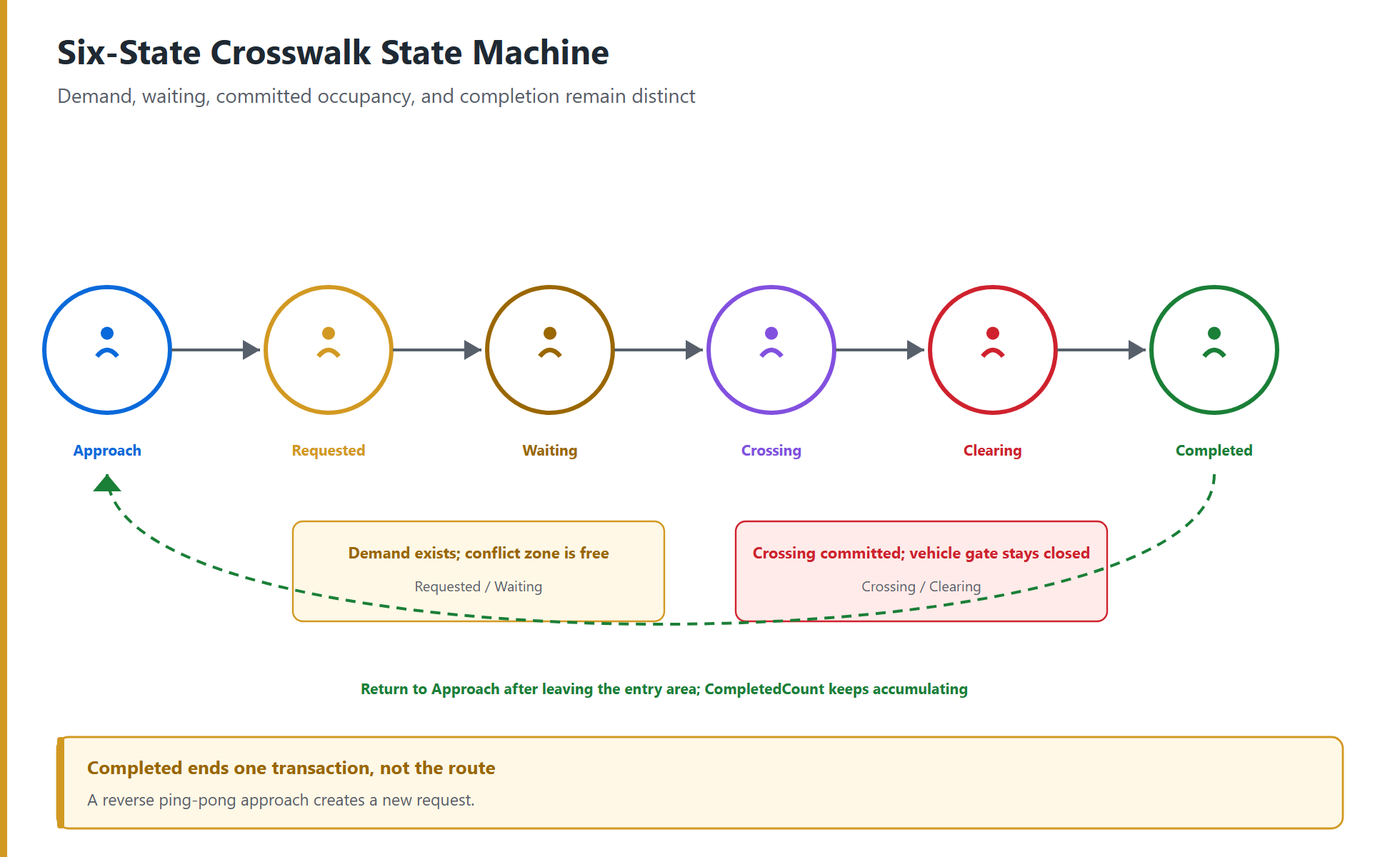
Six states describe one complete crossing
The runtime states are Approach, Requested, Waiting, Crossing, Clearing, and Completed. The header retains Leaving = Clearing as a compatibility alias, so old HUD labels may use either name. They are not separate enum values, and the earlier four-stage shorthand is no longer precise enough.
Each FCyberPedestrianCrosswalkAgentState stores CrosswalkId, original destination, entry, exit, waiting point, CrossingAlpha, WaitingSeconds, lateral offset, queue distance, QueueSlotIndex, completed count, and direction-initialization state. The state machine can run without a presentation. A checkpoint can restore these per-agent fields, although that does not imply that the whole intersection scheduling transaction has been restored.
Crossing permission reads both signal state and actual occupancy
The vehicle-safety contract is SignalPhase == VehicleGreen && NoAgentIn(Crossing, Clearing). Requested creates demand, and Waiting keeps that demand active. Crossing and Clearing mean that an agent has committed to and occupies the conflict zone.
| Pedestrian state | Demand | Conflict occupancy | Meaning for the vehicle gate |
|---|---|---|---|
| Approach | No | No | Does not change permission |
| Requested | Created now | No | Drives a signal transition; not occupancy |
| Waiting | Active | No | Waits for AllStop and pedestrian permission |
| Crossing | Committed | Yes | Gate must close |
| Clearing | Committed | Yes | Gate remains closed |
| Completed | No | No | Gate may reopen only in a legal vehicle phase |
ShouldOpenVehicleGate applies the contract in one place. The pre-step gate informs interaction. The post-step gate decides whether the red hazard advances in the current step. If a pedestrian enters Crossing this step, the post-step check closes the gate immediately and the hazard does not move. After the last Clearing agent exits, the gate remains closed through AllStop and reopens only on the next VehicleGreen with no conflict occupancy.

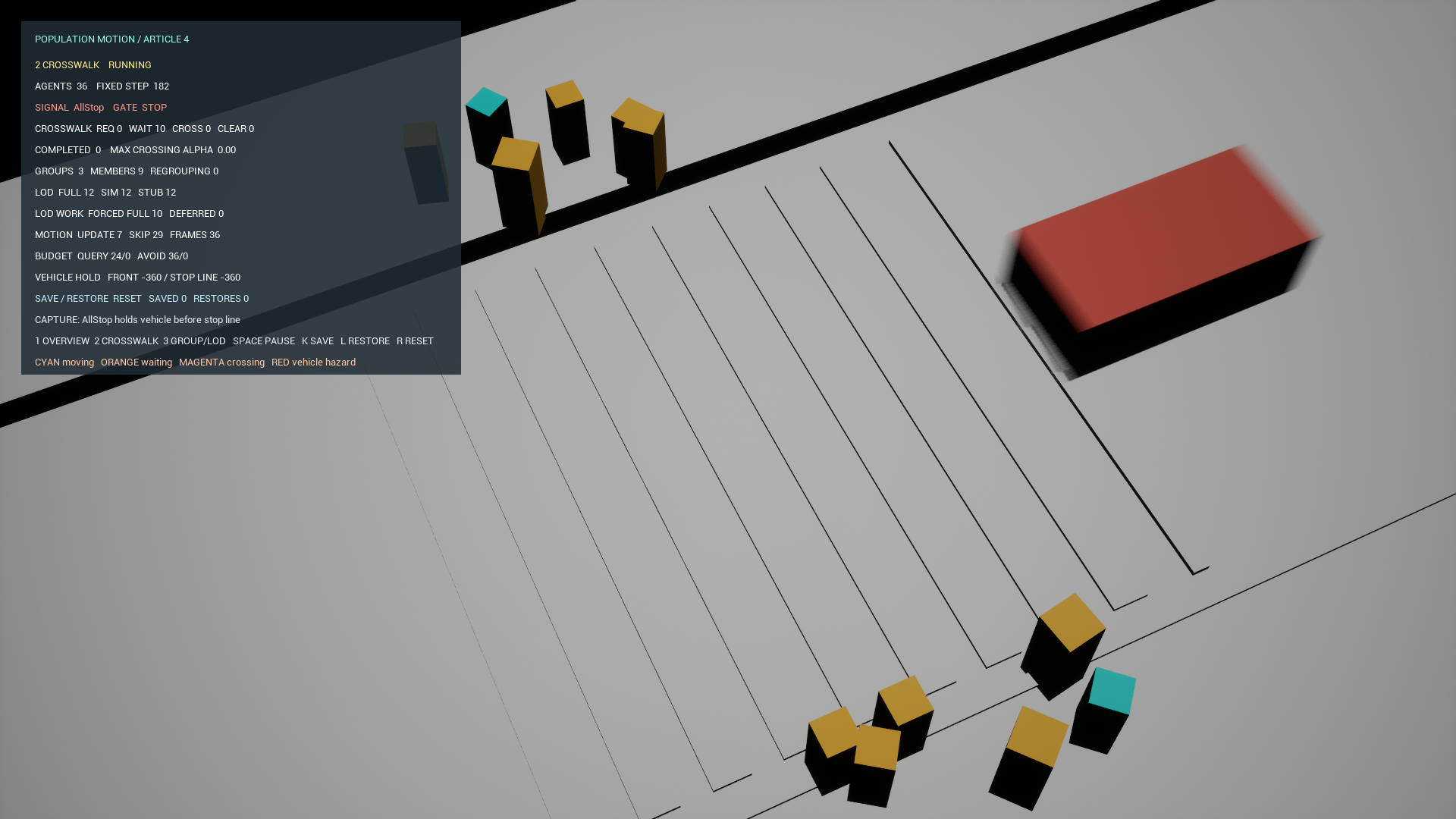
GATE STOP. Waiting agents remain at the entrance and the vehicle hazard stays behind the stop line.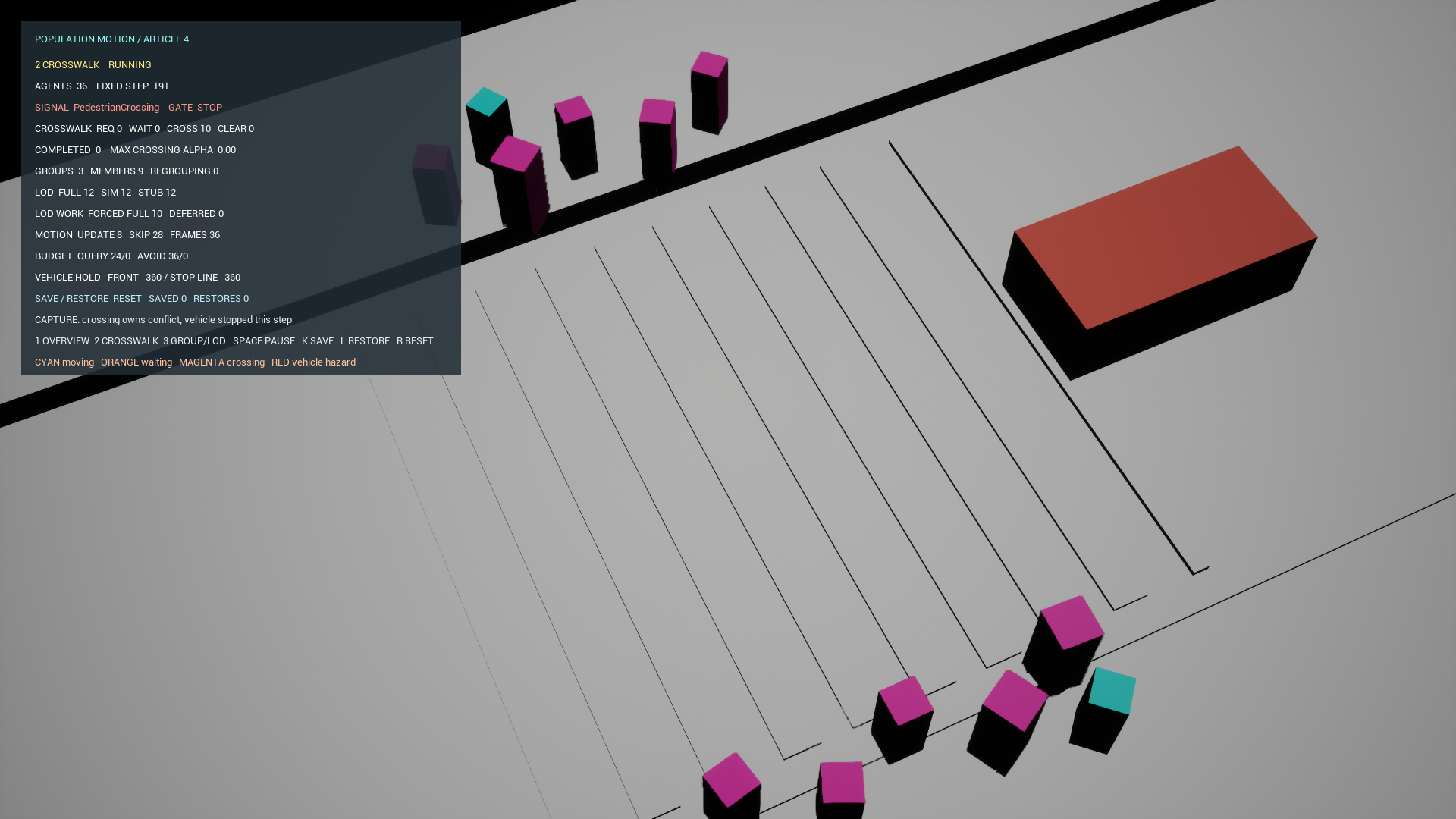
The hazard moves only while the gate is open and wraps from X=1200 to X=-1200. It is a constant-speed box, not the P11 vehicle-motion system. Its VehicleId, position, velocity, and 260 cm safety radius let pedestrian logic observe a moving hazard and yield. Vehicle envelopes, braking, and physical collision are outside P10.
Forced Full protects critical interaction
Requested, Waiting, Crossing, and Clearing AgentIds enter ForceFullAgentIds. Motion LOD marks them Forced Full so they are considered every step. Presentation still reads Applied Tier, so a visual promotion can be delayed by transition budget.
The fixture caps ordinary Full and Simulated capacity at 12 each. Forced Full bypasses MaxFullAgents: forced identities are ranked first and may exceed the ordinary Full target before the remaining agents compete for other tiers. ForcedFullCount exposes the excess, while the transition budget can still delay Applied Tier. This favors safety, but it has no independent emergency cap; the default-scale acceptance does not cover extreme queues.
The current flag also couples high-rate logic to Near presentation intent. A production split should separate ForceInteractionUpdate, ForceMotionUpdate, and ForcePresentationNear, with Crossing/Clearing above Requested/Waiting. A reliable waiting queue does not require a near-character resource for every waiting identity.

Liveness recovery is not the normal path
The coordinator tracks previous position, time without progress, previous CrossingAlpha, and recovery count for every identity. The HUD exposes Waiting Window Refresh, Forced Crosswalk Clear, Stalled Committed, and Maximum No Progress Seconds. These counters detect agents that stop making progress after commitment.
Forced clearance is a deadlock guard, not a normal completion mechanism. Repeated growth points to queue slots, vehicle gates, target synchronization, or local avoidance. Raising the timeout would hide the defect rather than fix it.
Queue slots define longitudinal rows and lateral crossing lanes
When an agent first binds to a crosswalk, the nearer side becomes Entry and the opposite side becomes Exit. The crosswalk width is divided into one to five lateral lanes. QueueSlotIndex % LaneCount selects a lateral lane, and integer division selects the queue row. Later arrivals stand 75 cm farther behind the waiting point for each row.
EntryPoint + LateralOffset
ExitPoint  + LateralOffset
WaitingPoint = EntryPoint - CrossingDirection × QueueDistance
The same state machine therefore supports two-way entry and multiple waiting rows. The queue remains regularized and does not model different body sizes, overtaking, or free-form standing.
Requested and Waiting remain separate even though both may render orange. Requested marks the step in which demand first appears; Waiting means that demand already exists and the identity remains in its assigned slot. WaitingCount includes both, but the distinct enum values reveal duplicate submission and missed first-step demand.
Once Crossing is committed, a light change cannot pull the agent back
Crossing and Clearing are committed states. Even if the signal phase changes, the agent continues toward the assigned exit while it remains on the crossing lane or holds the commitment. At 95 percent it enters Clearing; at the exit it enters Completed.
Signals decide whether new pedestrians may enter. They do not teleport an existing pedestrian back to the curb. The vehicle gate reads actual Crossing/Clearing occupancy and stays closed until the final committed agent leaves.
Completed ends one crosswalk transaction, not the ping-pong route. After the agent leaves the current entrance area, state returns to Approach. The reverse route can later create another Requested/Waiting cycle. CompletedCrossingCount accumulates completed transactions while current state initializes the next one.
A gap remains between P10 state and the P9 scheduling snapshot
P10 saves per-agent Requested, Waiting, Crossing, and related state, but not the full P9-style Intersection Scheduling snapshot. Restore rebuilds the default signal configuration and then reapplies pedestrian state. Restoring in the middle of Crossing will usually keep the vehicle gate closed through occupancy checks, but signal phase, demand sequence, and wait duration may not match the saved instant.
A production save must capture Crosswalk Agent State and intersection scheduling as one transaction. Restore should verify that every Requested/Waiting agent has a valid demand, every Crossing/Clearing agent owns the correct conflict zone, and no vehicle reservation is active in that zone. P10 completes the per-agent motion side only; this limitation remains explicit.
4. Groups, avoidance, and budgets: local relationships must not become all-pairs work
Groups retain a leader and formation slots
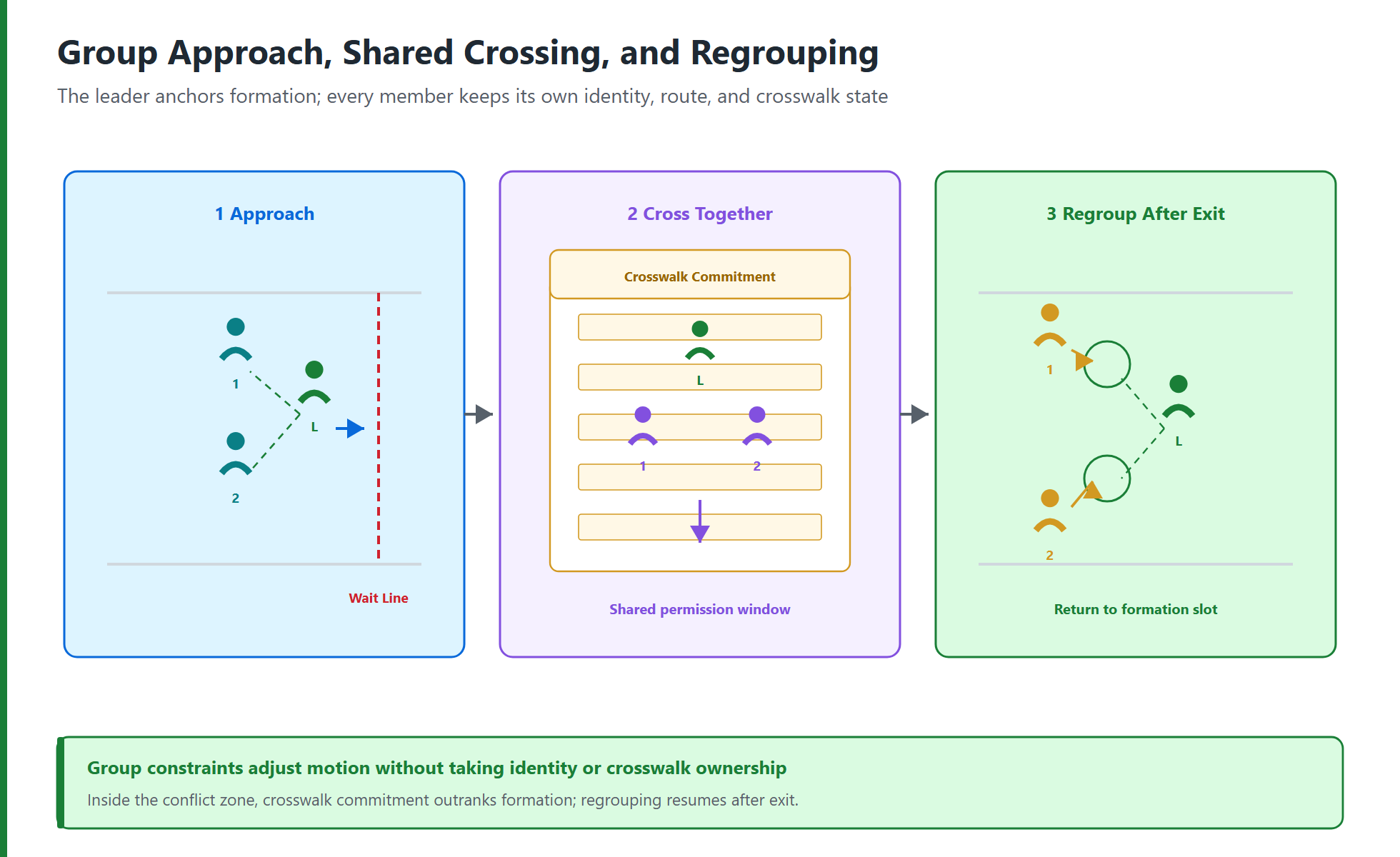
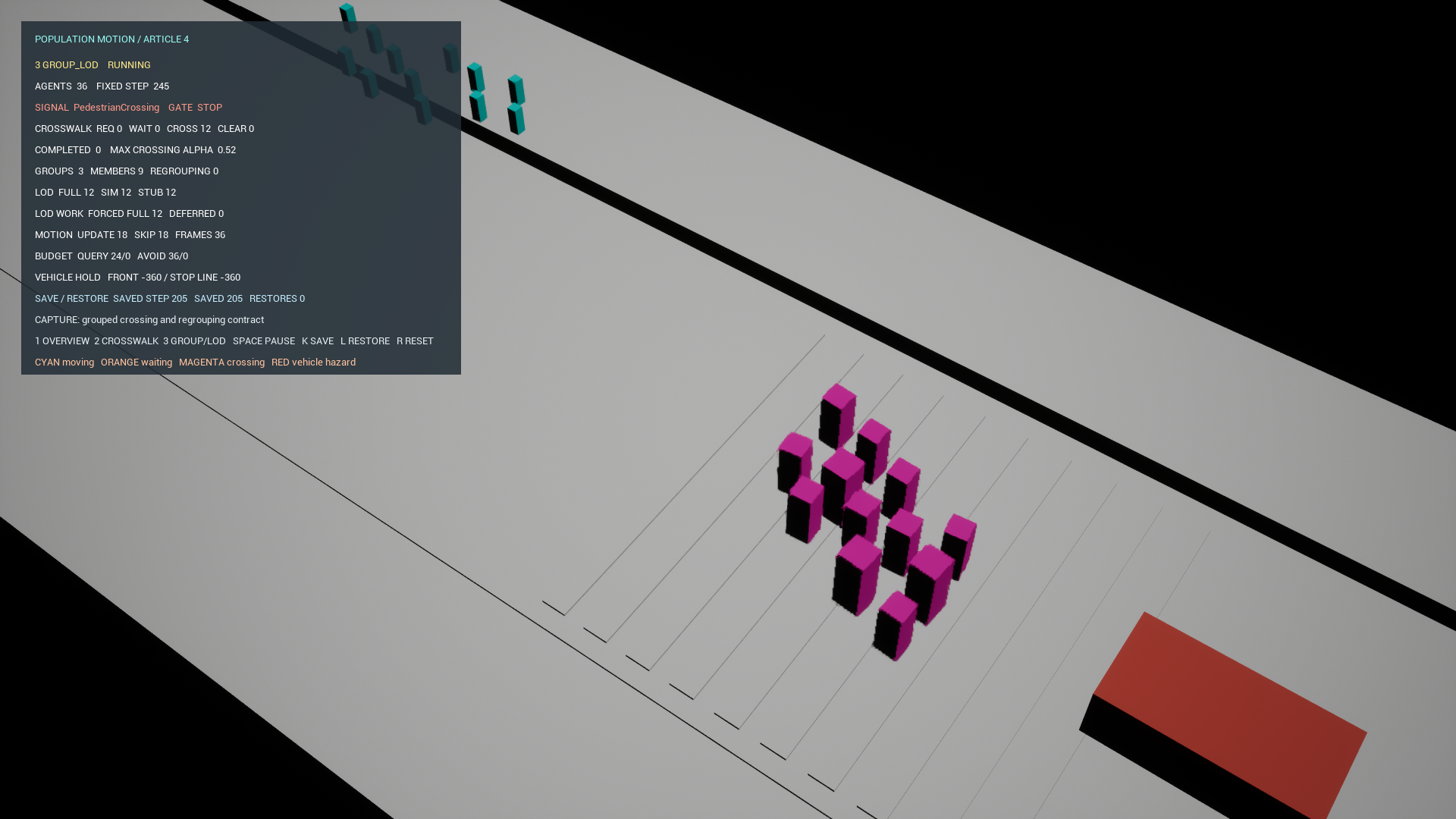
The demo assigns 25 percent of pedestrians to groups of at most three. Runtime state selects a Leader, assigns each member a Formation Slot, and reports GroupCount, MemberCount, and RegroupingGroupCount. Members share the crosswalk phase near an intersection so a vehicle gate cannot split a group after its leader passes.
Congestion or route turns may separate members temporarily. Once clear of the conflict zone, Regrouping draws them back toward their formation slots. Group constraints contribute to motion; they do not replace AgentId, route, or crosswalk ownership. Every separated member still has its own Motion Frame and Crosswalk State.
Avoidance uses spatial candidates and a bounded job count
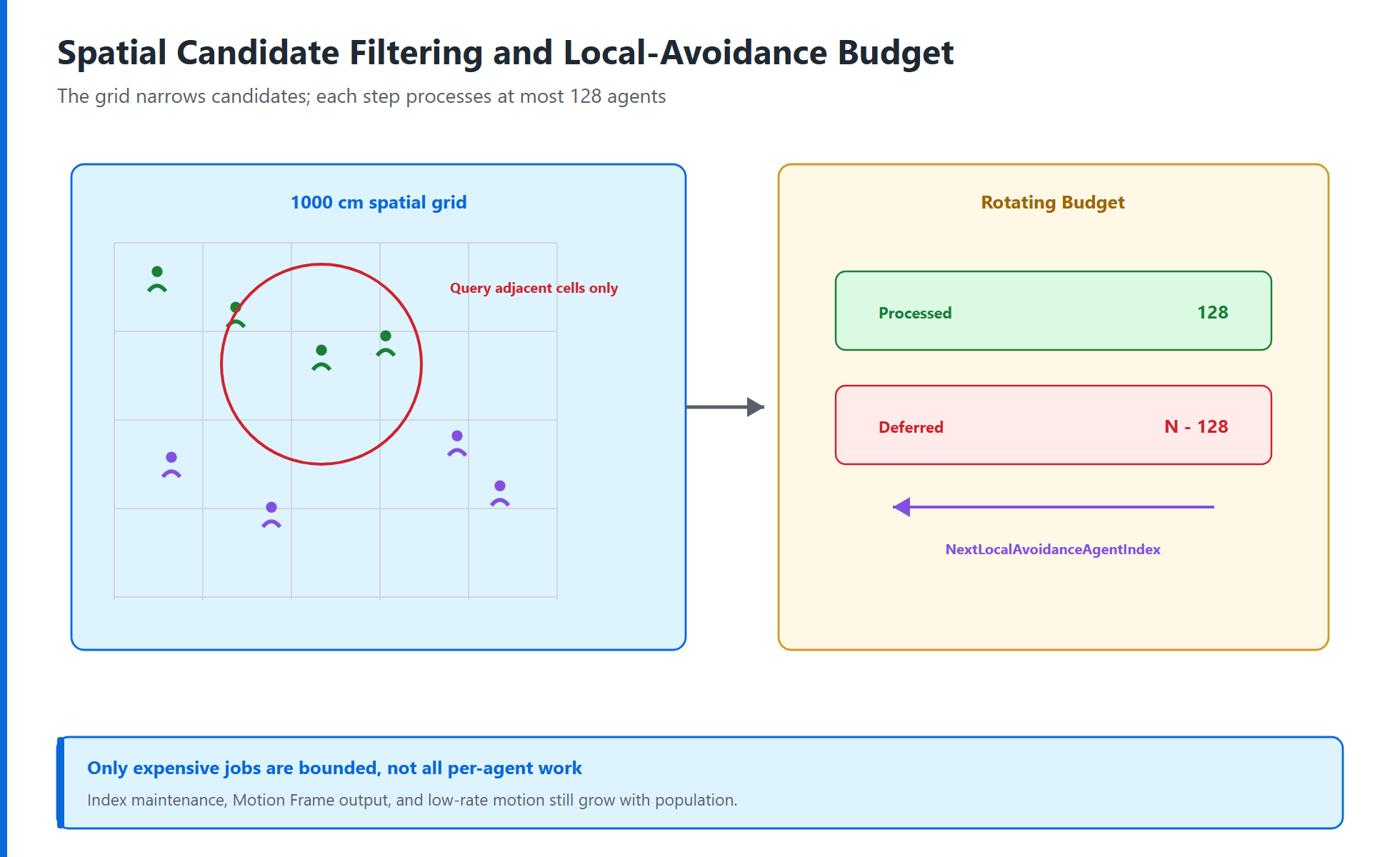
Local avoidance does not run a full N-squared comparison. A spatial index filters nearby candidates, Scratch State reuses temporary arrays, and a per-step budget decides how many agents receive new avoidance work. The rest are Deferred. Reports include adjusted count, processed and deferred jobs, and minimum spacing for the step.
Vehicle hazard response is a separate contribution. Hazard position, velocity, and safety radius produce Danger, Yield, or Waiting behavior. Route direction, group formation, static constraints, pedestrian separation, and vehicle response all feed locomotion; animation and box materials do not query nearby vehicles themselves.
The 100/300/1000 pressure test exposes both cadence throttling and the avoidance cap. The fixture invokes the coordinator at the Near budget, which processes at most 128 agents per step. NextLocalAvoidanceAgentIndex rotates the starting point.
| Logical agents | Motion updated | Motion skipped | Avoidance processed | Avoidance deferred | Observable Frames |
|---|---|---|---|---|---|
| 100 | 28 | 72 | 100 | 0 | 100 |
| 300 | 52 | 248 | 128 | 172 | 300 |
| 1000 | 140 | 860 | 128 | 872 | 1000 |
These are deterministic samples after 32 logical steps of 0.05 seconds, not target-platform performance budgets. Motion work remains roughly linear in total population, with a slope influenced by Stub cadence. Avoidance processing is capped at 128 in this fixture, but index maintenance, Motion Frame output, and other per-agent work still grow with population. Rotation creates later opportunities in a stable population; the table does not prove freedom from starvation under sustained insertion, deletion, or migration.
Crosswalk queries use the same Processed/Deferred distinction. A 1000 cm spatial grid restricts each query to nearby cells, and the per-step cap prevents every agent from scanning every crossing. The distinction avoids treating “no nearby crossing” and “not processed this step” as the same result. The acceptance map has only one crosswalk, so city-scale cell density, cross-zone updates, and streaming boundaries remain open work.
Motion contributions need an explicit composition order
Route, group, and avoidance logic must not overwrite velocity independently. A safer order begins with desired route direction and then applies bounded corrections:
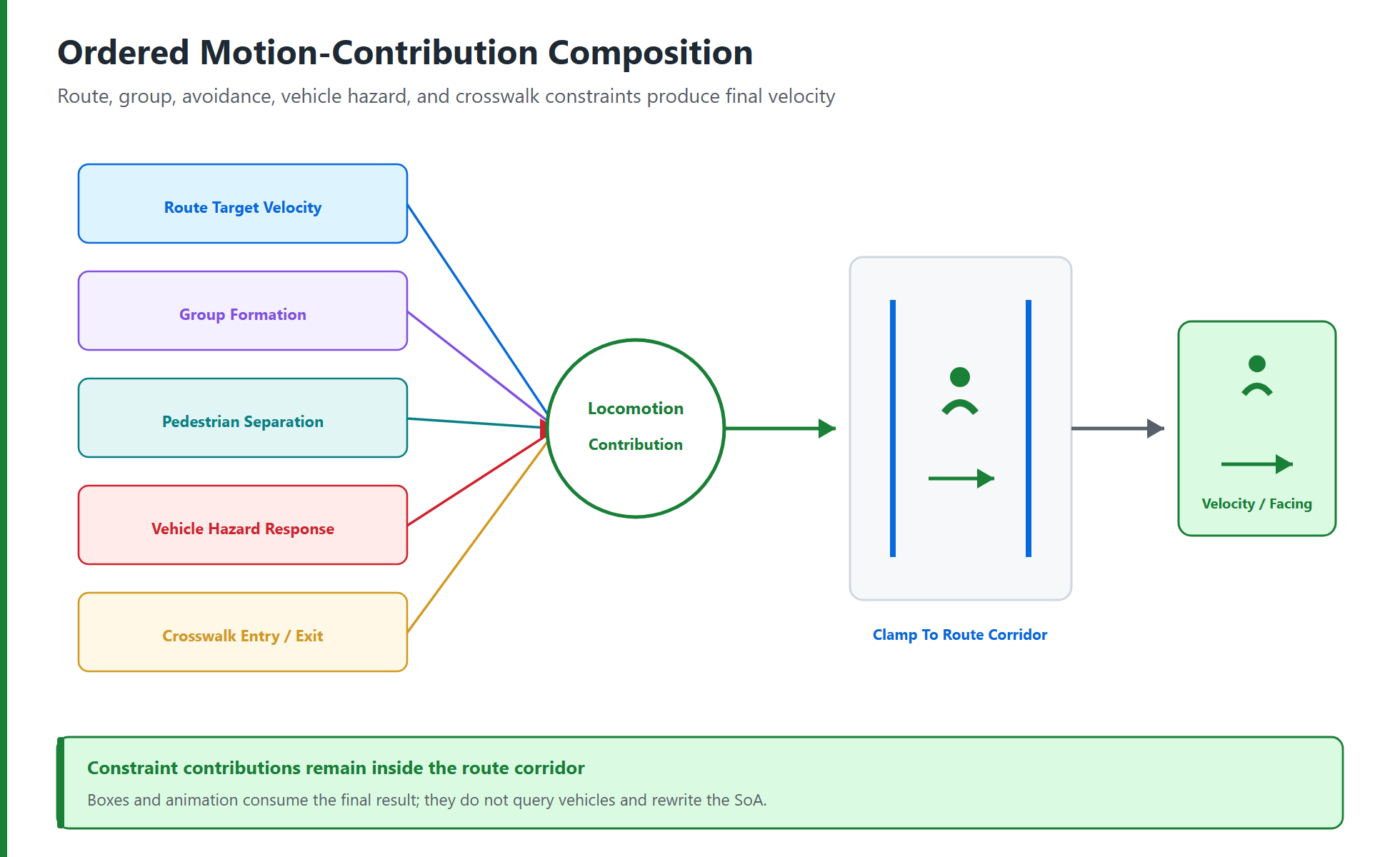
Crosswalk Commitment outranks ordinary formation correction: an agent already inside the conflict zone cannot step out of the crosswalk merely to return to its leader. A vehicle hazard may keep an uncommitted pedestrian waiting, but cannot freeze a committed pedestrian in the middle of a traffic lane. Group and avoidance corrections also remain within the 65 cm route corridor.
The prototype uses rule-based corrections rather than velocity obstacles, RVO, or a continuum crowd model. Priorities and outputs remain observable, so a local algorithm can change without rewriting AgentId, crosswalk ownership, or the Motion Frame contract.
When an avoidance job is deferred, the system must not zero velocity or consume uninitialized data. The agent continues from its last reliable route state, subject to higher-priority crosswalk and vehicle-hazard rules, and receives another chance later. At 300 agents, 172 avoidance jobs are deferred; at 1000, 872 are deferred. Those identities still publish frames. Complete logical identity and bounded expensive work can coexist.
The spatial index also needs budget telemetry. Cells that are too large can accumulate too many candidates; cells that are too small increase migration cost. The fixed 1000 cm size proves repeatability in this fixture only. A city deployment should record population distribution per cell, visited cells per query, hit rate, update cost, and worst-case candidates in stations, events, and evacuations.
5. Motion Frames, presentation tiers, and recovery
Every identity publishes one observable frame
At the end of a step, the coordinator emits a Motion Frame containing AgentId, Location, Velocity, Speed, Facing Direction, Route Target, behavior state, group data, Crosswalk State, animation parameters, and Presentation Tier. Presentation constructs a Transform from Location and Facing Direction. ObservableFrameCount must equal the logical agent count even when some Stubs did no motion work this step.
The frame is the authoritative presentation input for that step and a read-only snapshot derived from the SoA and coordinator. Persistent ownership of identity, route, position, and velocity remains below it. The frame is neither the sole SaveGame source nor an input written back into the next motion step. The current ISM adapter groups boxes into Moving, Waiting, and Crossing sets and scales them by tier. Future Skeletal Mesh, AnimInstance, or batch-proxy consumers should read the same contract.
FCyberPedestrianObservableFrame currently lacks SimulationFrameIndex, SourceAgentFixedStepCount, and bMotionUpdatedThisStep. Therefore ObservableFrameCount == AgentCount proves that every identity has consumable output, not that every position, avoidance response, or crosswalk result was recomputed this step. Production consumers that care about freshness need those fields.
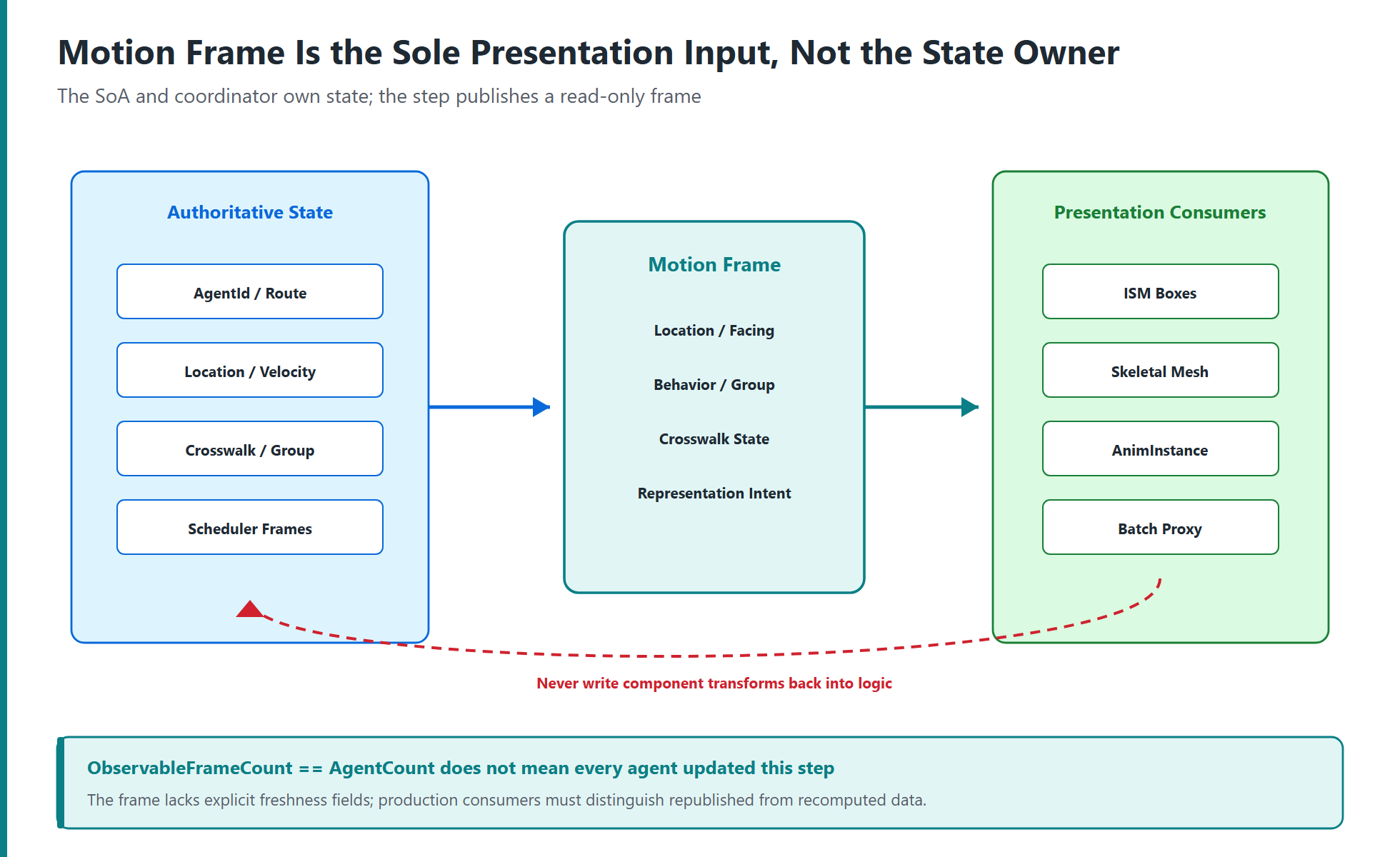
This article does not claim finished animation. The project already has binding paths for Speed, FacingYaw, DesiredYaw, TurnDelta, Direction, Moving, and Turning, but P10 acceptance uses boxes. Production skeletons, clips, gait phase, Foot IK, and crowd materials are not connected yet.
LOD combines distance hysteresis, capacity, and transition budgets
Default Full range enters at 25 m and exits at 32 m. Simulated enters at 55 m and exits at 65 m. Different thresholds provide hysteresis. Full and Simulated capacities are 12 each; inherited transition budgets permit at most 12 promotions and 24 demotions per step.
Requested Tier comes from distance and Force Full. Capacity Target resolves competition. Applied Tier still reflects transition budgets, and Motion Frame publishes Applied Tier. Deferred LOD Transition means that a requested change did not complete this step; it does not mean the identity vanished.
Presentation Tier is an intent, not an Actor lease. The demo maps it directly to box size. In production, P7's representation budget and resource manager must decide between a Skeletal Mesh Actor, ISM, batch proxy, or no visible representation.
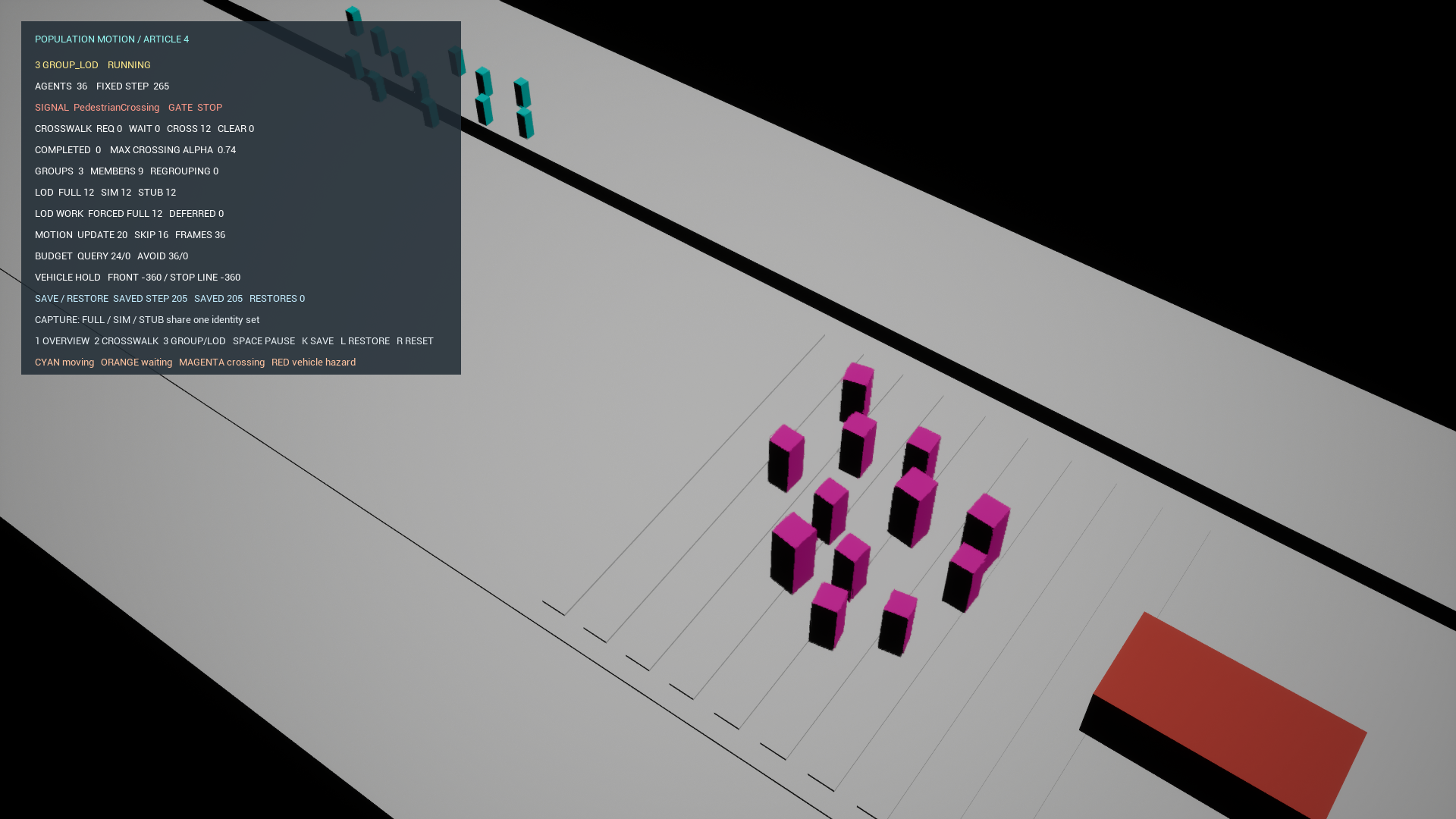
A snapshot restores identity, route, per-agent crossing state, and scheduler frames
Snapshot version 1 stores FixedStepCount, the SoA Scheduler Frame, LOD Scheduler Frame, liveness counters, the traffic hazard, and the following fields for each agent:
- AgentId, Position, Velocity, CurrentTargetIndex, and PingPongDirection;
- AgentFixedStepCount and liveness-monitor fields;
- LOD Tier;
- full Crosswalk State, entry, exit, waiting point, alpha, wait time, queue slot, and completion count.
Load first configures the same deterministic AgentIds and routes, then applies records by ID. It restores both Scheduler Frames so hash cadence continues and synchronizes Navigation PreviousPositions to restored positions, preventing the load displacement from becoming a false high velocity.
The snapshot does not include IntersectionScheduling. Configuration rebuilds default signal state, then restores pedestrian crosswalk fields and the vehicle hazard. The fixture proves route, crossing, LOD, and continued motion recovery. It does not prove restoration of signal phase, fairness queues, and every intersection transaction.
A complete restore should validate the whole snapshot first, restore P9 Intersection Scheduling and Conflict Zone ownership, restore each Crosswalk Agent State, verify the demand and occupancy relationships, restore motion schedulers, and only then publish new Motion Frames. The fixture does not implement this cross-system atomic sequence.
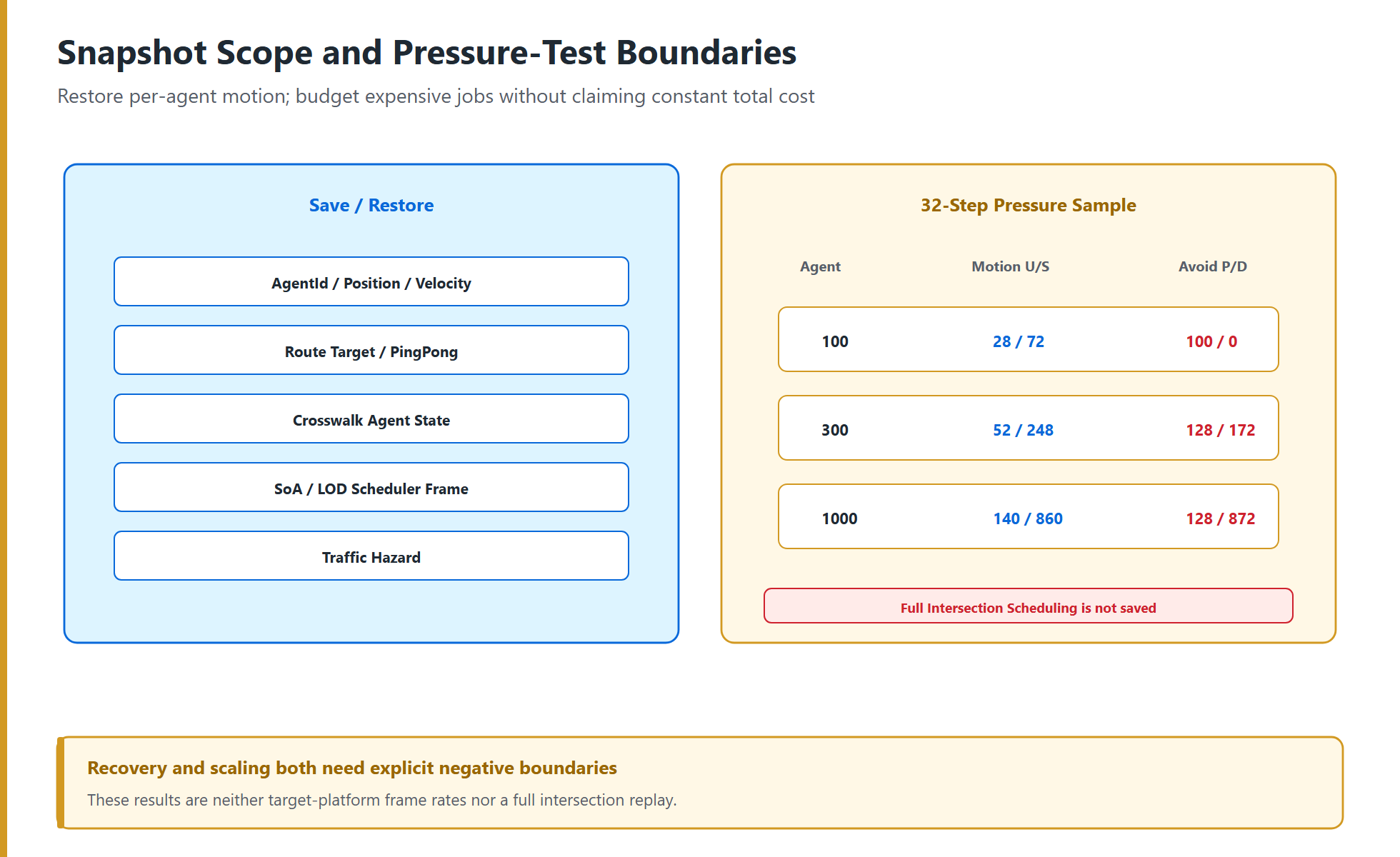

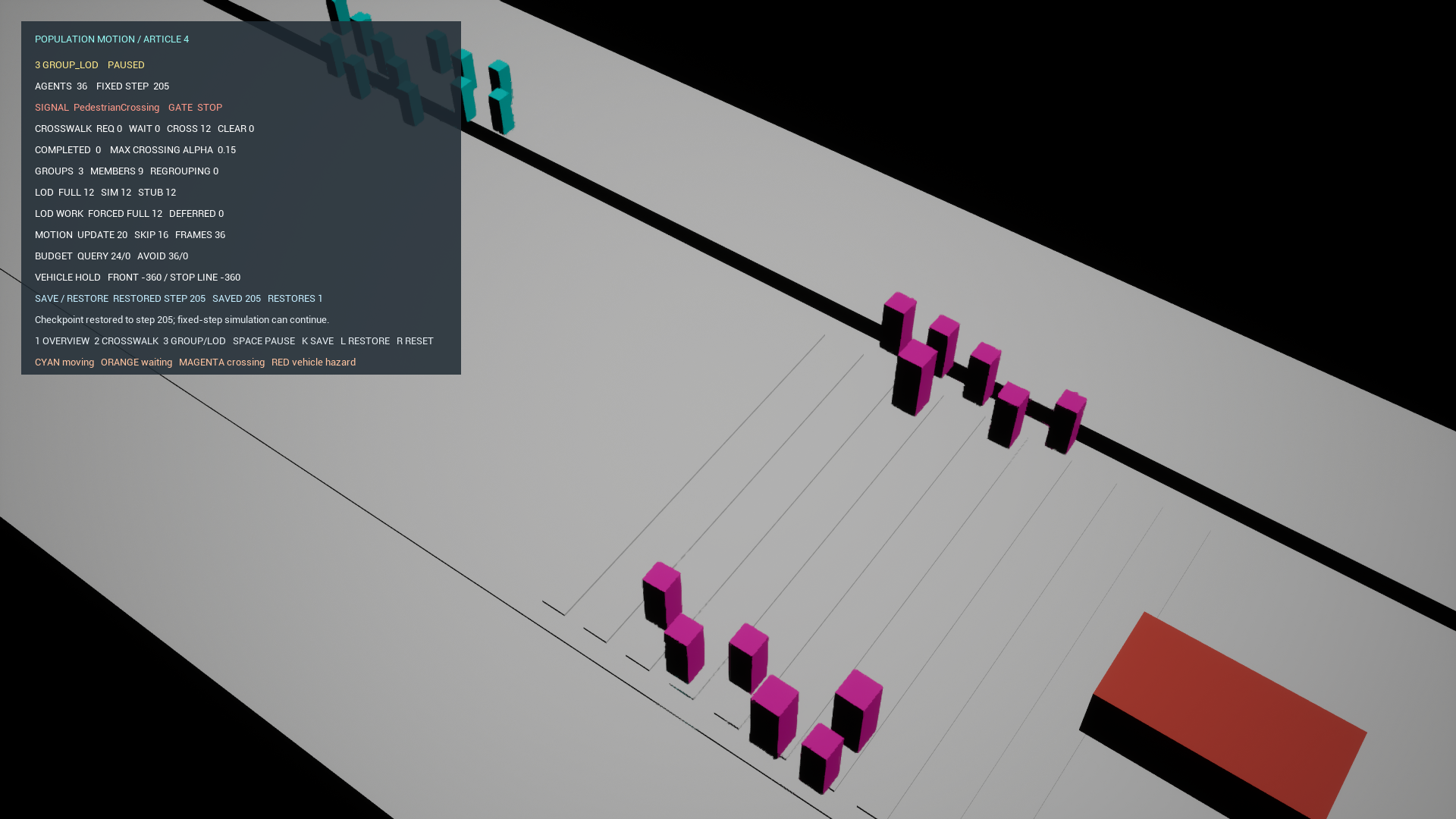
Restore currently reconfigures the live object before applying every field; it is not atomic. An invalid AgentId can fail after partial configuration. Production code needs temporary state and full validation before commit.
Presentation needs normalized action intent rather than every internal SoA column:
| Motion Frame field | Animation use | Must not modify |
|---|---|---|
| Speed / Velocity | Idle, Walk, Jog, and playback rate | SoA velocity |
| Facing / Desired Yaw | Turn, directional blend, upper-body offset | Route target |
| Crosswalk State | Wait, look, or clear-road tags | Signal and conflict ownership |
| Group Role | Leader/follower posture and look-back behavior | Formation Slot |
| Presentation Tier / Representation Intent | Skeleton update rate, material, or instance path | AgentId and route |
A later animation system can quantize continuous speed into gaits or use Motion Matching. Root Motion still needs an explicit agreement with logical displacement. If root motion owns position, a Stub or non-skeletal representation cannot continue the route. If it is ignored entirely, feet may slide. P10 supplies the logical frame; alignment belongs to the presentation implementation stage.
Tiered presentation is not tiered identity
Full, Simulated, and Stub alter update cadence and presentation cost. They share the same AgentId, route target, Crosswalk State, and Group Membership. Promotion does not create another pedestrian, and demotion does not delete the identity.
P10 tiers must align with P7 representation leases. P7 decides which stable population identities receive a full Actor, simplified instance, or debug marker. P10 supplies Motion Frames for those identities. The tiers can map to each other, but P10 must not spawn a new population. Population orchestration selects identities, motion updates positions, and representation management consumes Applied Tier.
Ephemeral ISM indices, component references, and color-group slots are rebuildable caches. Saving them would bind the snapshot to the current component order. Restore writes logical state by AgentId and then rebuilds Moving, Waiting, and Crossing instances from Motion Frames. The same principle applies when boxes become pooled Skeletal Mesh Actors: save logic and any necessary animation phase, then reacquire Actor pointers, handles, and instance indices in the current world.
6. Acceptance evidence and capability boundaries
Manual walkthrough
- Use an overhead view that includes both sidewalks, the crosswalk, and the red vehicle.
- Observe a complete Requested → Waiting → Crossing → Clearing → Completed cycle.
- Confirm that the vehicle gate stays closed during AllStop, PedestrianCrossing, and Crossing/Clearing occupancy, then waits for the next VehicleGreen before reopening.
- Observe a three-person group approach, cross together, separate, and regroup.
- Move the observer and check gradual Full/Simulated/Stub changes.
- Compare Motion Updated/Skipped with Processed/Deferred while Frame count remains equal to Agent count.
- Save, continue into another phase, restore, and verify route, queue slot, and tier continuity.
Automated evidence
PopulationMotionDemoRuntime covers space construction, fixed-step routing, all six crossing states, groups, vehicle hazard response, LOD, Motion Frames, and continuation after restore. It verifies the vehicle-gate truth table across three signal phases, the same-step stop when an agent enters Crossing, and the Crossing/Clearing → AllStop → VehicleGreen reopening order. Map and presentation checks validate boxes, GameMode, HUD, road, and crosswalk wiring. PopulationMotionPressure100_300_1000 requires unique AgentIds, complete observable frames, deterministic cadence, and deterministic deferred-work counts at all three scales.
The initial frozen tag is article4-pedestrian-motion-demo-v1, and the acceptance-map blob is ce7c580e82c2ed61c047e03e0b4715fa632dc85f. Vehicle-gate closure was tightened in 0f11f742; crosswalk clearance and vehicle resume were fixed in aa29e247. Final results are reopenObserved=1/1, crossingEntry=1/1, vehicleOverlap=0, and stopLineViolations=0. ClientEditor build, CyberPlayableSliceSmoke, PopulationMotionDemoRuntime, PopulationMotionPressure100_300_1000, and CyberValidationAll pass. ValidationAll reports zero errors and four existing expected warnings—not zero warnings.
P10 demonstrates that:
- AgentId, route, and motion state can exist without a full Character;
- project-owned pedestrian space can describe sidewalks, a crosswalk connector, and portals;
- the SoA advances through fixed steps and LOD masks while every identity still publishes a Motion Frame;
- crossing state is connected to vehicle gate, signal state, and conflict occupancy;
- groups retain a leader, formation slots, synchronized crossing, and regrouping;
- crosswalk and local-avoidance queries have processed/deferred budgets;
- route, per-agent crossing state, tier, and scheduler frames continue after a session snapshot.
It does not establish general city-scale pathfinding, complex-terrain capsule collision, production animation, Foot IK, final avoidance quality, streamed cross-zone pedestrian space, or complete intersection-scheduling persistence. The boxes expose contracts; they are not the final presentation.
Acceptance still required before production characters
Characters introduce problems that boxes do not expose: capsule width versus crosswalk-lane width, turn radius versus the route corridor, skeleton stride versus logical speed, Foot IK at curbs, and visual collision during group avoidance.
The next stage should add at least:
- fixed-camera overlays of logical paths and pelvis trajectories;
- foot-sliding measurements across characters with different stride lengths at one Agent speed;
- capsule-sweep failure rates at entrances, curbs, and turns;
- animation phase and facing error during Full/Simulated transitions;
- minimum visual spacing during Group Regrouping;
- separate timing for skeleton updates, animation evaluation, and instance drawing at 100/300/1000 identities;
- first-animation-frame alignment with restored Motion Frame state.
These tests retain the P10 motion contract. If route, crossing, or identity starts depending on Actor Tick after character integration, presentation has crossed the ownership boundary; the logic prototype should not be discarded for that failure.
Data seams with P7 and P9
P7 owns population identity, zones, schedules, and representation leases. P9 owns signal state and Conflict Zone permissions. P10 turns those inputs into continuous poses:

The standalone fixture substitutes deterministic AgentIds and fixed routes for P7 schedules, and an embedded scheduling fixture for the complete P9 snapshot. That makes P10 independently testable while preserving the integration boundary: fixture routes are not final community schedules, and two signal systems must never become simultaneous authorities.
Conclusion: presentation can change, but Motion Frame remains its sole input
P10 does not deliver a collection of walk animations. It delivers a budgeted, restorable motion-data path. The SoA stores identity and route, LOD produces update masks, the coordinator resolves crosswalks, groups, and hazards, and Motion Frame publishes the result to presentation. The frame is the sole presentation input, not a replacement for lower-level state ownership. Whether a full character exists does not change AgentId or crosswalk ownership.
P11 moves to the vehicle execution layer. P8 decides when a vehicle may enter the road, P9 decides whether it may acquire the next section of space, and P11 tests continuous fixed-step execution for vehicle envelopes, car-following brakes, stop lines, collision damage, and repair.
AI Collaboration Retrospective
- AI-assisted work: source-runtime evidence retrieval and review of the UE5 pedestrian-space, SoA, crossing, group, LOD, query-budget, Motion Frame, snapshot, and pressure-test paths.
- Major corrections: replaced the older four-stage crossing shorthand with Approach/Requested/Waiting/Crossing/Clearing/Completed; identified Leaving as a Clearing alias; separated update cadence from speed equivalence; preserved the missing full Intersection Scheduling snapshot as an explicit limitation; tightened the vehicle gate to VehicleGreen with no conflict occupancy; added same-step stop and post-clearance reopening tests.
- Human judgment boundary: the article does not present box rendering as production animation or a one-crosswalk spatial index as completed city pathfinding.
- Verification basis:
CyberPopulationMotionDemoActor, SoA/Locomotion, PedestrianSpace, Crosswalk, Group, MotionLOD, Observable Runtime, pressure cases, and the Article 4 acceptance record. - Remaining risks: Stub time compensation needs redesign, Forced Full has no independent extreme-crowd cap, restore is not atomic, and signal phase plus fairness queues are not fully persisted.
2 thoughts on “Urban Vitality P10 | UE5 Pedestrian Motion: Fixed Steps, Crosswalk State, and Tiered Updates”